

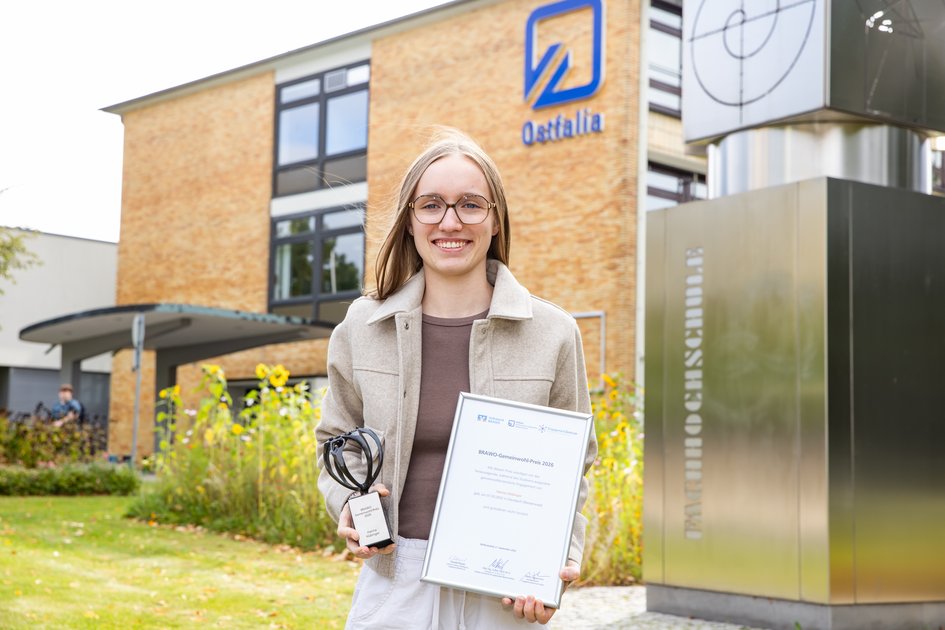
University studies, youth work and emergency response: Hanna Hübinger is studying early years education and health at the Ostfalia campus in Wolfsburg and began volunteering with the Technisches Hilfswerk (THW) at the age of eleven. Today, she is in charge of youth work herself. She was awarded the BRAWO Public Welfare Prize for her commitment.
Mandy Fleer, Ostfalia editorial team: Hanna, you’re involved with the THW. What exactly do you do there?
Hanna: I joined as a junior volunteer when I was eleven and completed my basic training at the age of 16. At 18, you’re allowed to go out on missions – I’ve been an active member of the emergency response team ever since. I’m also involved in youth work. After moving to Wolfenbüttel to study, I was appointed local youth representative here. I also do youth work at national level.
How did you get involved with the THW as a child?
Hanna: A friend asked me back then if I’d like to come along. I gave it a go and was immediately hooked. The technology fascinated me because I’d never had any experience with it before. And I also loved the prospect of helping people.
Have you ever thought about giving it up over the years?
Hanna: No. Only right at the very beginning, when I was there for the first or second time. I suddenly thought, ‘I have to go out on missions at the age of eleven,’ and I got scared. But then I was reassured that I still had plenty of time to think it over.
You’re very involved in youth work. What do you enjoy most about it?
Hanna: I still remember how enthusiastic I was myself as a child. Experiencing the camp-outs and the sense of camaraderie just feels wonderful. It’s a brilliant hobby that teaches discipline, team spirit and democratic values. That’s what I want to pass on now.
You’re also active as a volunteer rescue worker. What do your duties involve?
Hanna: I work as a rescue assistant. My dutiesinclude searching for missing people, shoring up walls or clearing rubble. During an operation in Wolfenbüttel, for example, we shored up several houses and created access routes so that the search for a missing person could continue.
How do you feel when you’re heading out on a call-out?
Hanna: It’s always a bit nerve-wracking, because you never know exactly what to expect. My first call-out where people’s lives were at risk was particularly intense. We were on the scene within five minutes because we were right nearby. Scheduled call-outs, on the other hand, have become quite routine for me now.
How much time does your voluntary work take up alongside your studies?
Hanna: A great deal. In recent years, I’ve spent more than 1,000 hours a year on regular shifts, drills, camps and other events. On top of that, I prepare for youth group sessions at home or take part in video conferences. You really have to want to do it – it takes up a lot of time.
How do you balance your studies with your voluntary work?
Hanna: My studies come relatively easily to me because I’m interested in the subject matter. Even so, every other weekend is taken up by the THW. It also helps that my partner is in the THW himself and therefore understands my commitment.
What does winning the BRAWO Public Welfare Prize mean to you?
Hanna: I was, of course, delighted to receive it. Volunteering isn’t recognised very often, and when it is, it tends to be within one’s own organisation. That’s why it’s something special when your commitment is also recognised by the wider public.
What advice would you give to students who are thinking about getting involved too?
Hanna: Just give it a go. You can always go along and have a look around first. You don’t have to invest as much time as I do either. The most important thing is to find something you enjoy.
With the BRAWO Public Good Award, Volksbank BRAWO, the EngagementZentrum – the bank’s public-good-oriented subsidiary – and Ostfalia University of Applied Sciences have been honouring students annually since 2021 who have shown exceptional commitment to volunteering for the benefit of others. The next application round for the prize will begin in March 2027.