

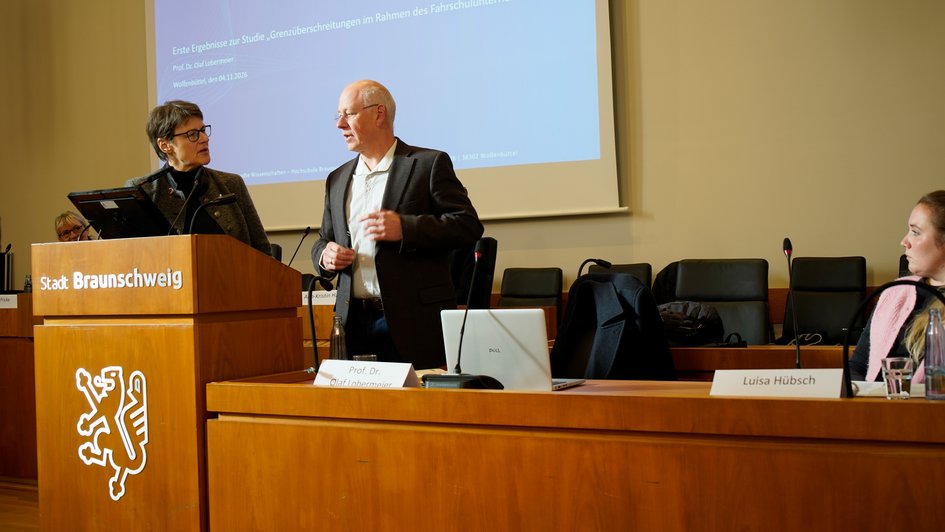
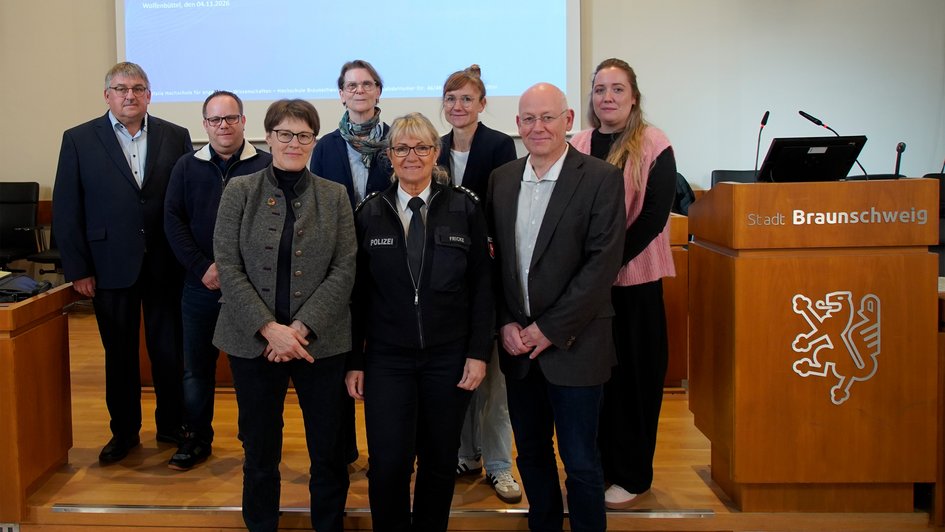
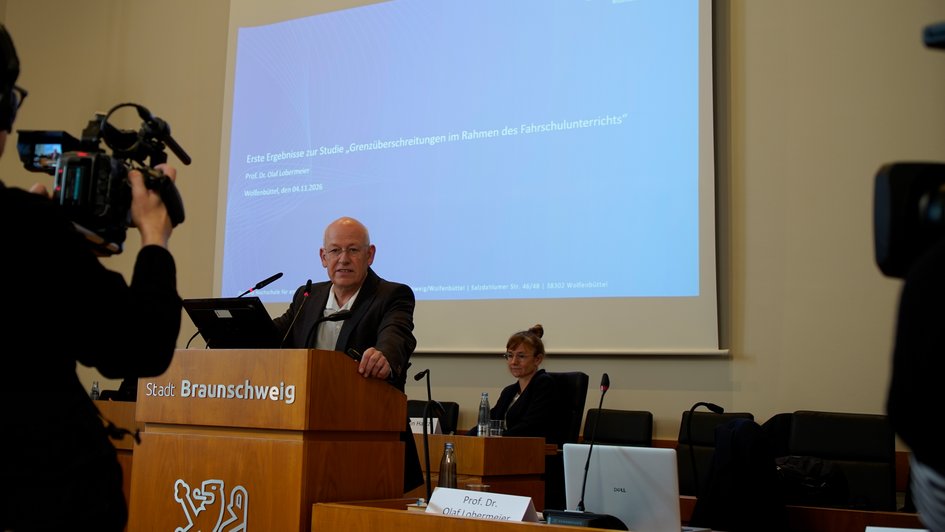
Together with members of the Round Table against Sexual Violence against Children and Young People, Prof. Dr Olaf Lobermeier from the Faculty of Social Work at Ostfalia University of Applied Sciences presented a study which, for the first time, provides data on sexual assaults during driving lessons. The Lower Saxony Driving Instructors’ Association (Fahrlehrerverband Niedersachsen e.V.) welcomes the study and intends to develop measures based on the findings. The working group plans to engage in dialogue with driving schools and associations to launch prevention strategies and awareness-raising campaigns.
For the representative survey entitled ‘Inappropriate behaviour during driving lessons’, around 10,000 young adults born between 2000 and 2009 in Braunschweig were contacted by post in June and July 2026. 928 people took part in the anonymous online survey.
What the results show
- 41 per cent of young women stated that they had personally experienced inappropriate jokes and comments during driving lessons. Among young men, the figure was 19 per cent. Other instances of inappropriate behaviour included, amongst other things, intrusive or suggestive remarks, sexual innuendo, leering, unwanted physical contact, invitations to private meetings or unwanted messages of a sexual nature.
- 23 per cent of the women affected rated the incident as ‘bad’ or ‘very bad’; for men, the figure was 12.5 per cent.
- The majority of those affected did not report the incident. The most common reasons were: they saw no need to do so (64.1 per cent), it was not serious enough (55.5 per cent) or the offence could not be proven (19.9 per cent).
- 22.8 per cent of young women and 8.6 per cent of young men stated that they felt somewhat or very insecure following the incident.
Who are the perpetrators, and where do the assaults take place?
In 68 per cent of cases, the incidents took place in the driving school car; less frequently during theory lessons. 88.6 per cent of those surveyed stated that the perpetrator was male. The majority estimated the perpetrator’s age to be between 41 and 50 years or older.
Dr Olaf Lobermeier, a professor at Ostfalia University who led and carried out the study, says: “We expected that many young people had experienced sexualised boundary violations during driving lessons. We know from similar studies in sport that such transgressions are not isolated incidents. However, the striking accounts provided by the young people in their open comments make it very clear that this problem cannot be ignored. It is primarily young women whose quality of life is permanently affected by this.”
Ines Fricke, the Youth Affairs Officer at Braunschweig Police Station, is not surprised by the findings. As part of her school lessons on violence prevention, pupils have repeatedly told her about inappropriate behaviour by driving instructors during their driving lessons. What is worrying is that the young female learner drivers did not make the behaviour public, either out of insecurity or shame, and so there were no consequences for the offending driving instructor.
Ann-Kristin Hartz, managing director of Sichtbar. Fachzentrum gegen sexualisierte Gewalt e.V., adds: “As well as the dependence of learner drivers on their driving instructors, there is also a power imbalance. The situations in which assaults occur are primarily those where no other people – i.e. potential witnesses – are present, meaning the credibility of the victims can quickly be called into question. It is a ‘he-said, she-said’ situation coupled with the fear that ‘nobody will believe me anyway’. Furthermore, victims often blame themselves for not defending themselves sufficiently or for having sent out ‘the wrong signals’.”
The youth counselling service bib in Braunschweig sees a clear need for action in the findings. Although many victims classify the incidents as ‘not serious’ and therefore do not report them, the data on feelings of insecurity and the impact on quality of life (significantly higher among women) show that the consequences are very real. The pattern of boundary violations (a high proportion of male perpetrators, driving school cars frequently being the scene of the offence, and the majority of perpetrators aged 41 and over) points to structural gaps in prevention measures at driving schools.
“I find it alarming that 22.8 per cent of young women and 8.6 per cent of young men feel their sense of safety has been compromised after their driving lessons – and that they have even paid money for this,” sums up the local equal opportunities officer, Marion Lenz. “I’m glad we’re shedding light on this hidden issue.”
The Lower Saxony Driving Instructors’ Association (Fahrlehrerverband Niedersachsen e.V.) is also taking the findings very seriously. Its chairman, Klaus Napierski, welcomes the study: “There have been repeated individual allegations, but we lacked the facts. What exactly is happening, where and how often? At last we have facts, which we will examine thoroughly in order to develop meaningful and targeted measures. Because things cannot carry on as they are. I would like to express my sincere thanks to the working group, in which one of our board members has been actively involved.”
The working group
The framework for the survey was developed by the ‘Driving School Working Group’ of Braunschweig’s ‘Round Table against Sexualised Violence against Children and Young People’, which addresses the issue of sexual assaults in driving schools. This working group comprises the City of Braunschweig’s municipal equality officer, the prevention team at Braunschweig Police Station, the Braunschweig driving schools ‘Ulrike Kasper’ and ‘Zachmann’, the youth counselling service bib, and ‘Sichtbar. Specialist Centre against Sexual Violence’.