

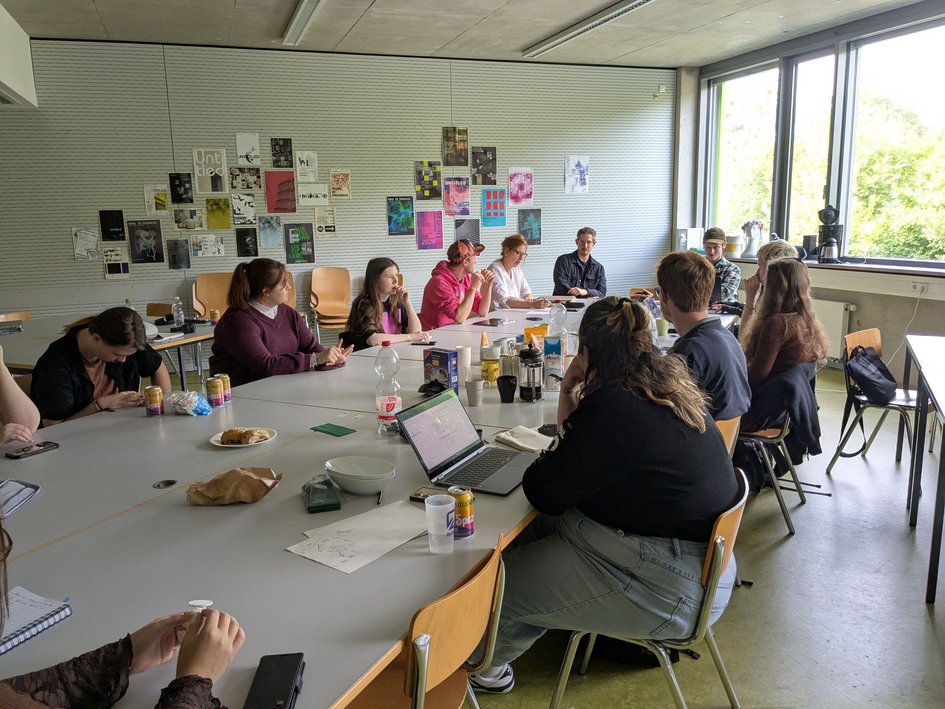
In September, the Salzgitter campus of Ostfalia University was transformed into a laboratory for media responsibility for five days. Under the title “Making It Sayable – Media Responsibility from Gleichschaltung to Algorithms”, students from various years and disciplines, together with lecturers and invited guests from academia, the field of remembrance culture and civil society, explored how the media shape public opinion and what responsibilities are borne by those who produce images, texts and online networks.
The week was underpinned by a dual aim: historical self-reflection and an engagement with the digital present. To kick things off, the students visited the Drütte Concentration Camp Memorial in Salzgitter-Watenstedt in cooperation with the City History Working Group. In the evening, this was followed by a group screening of Leni Riefenstahl’s *Triumph of the Will*, a propaganda film made in 1935 that is still regarded today as a benchmark for the cinematic construction of political power. Taking this historical reference point as their starting point, keynote talks, workshops and discussions explored topics ranging from deepfakes and algorithmic reach to the EU’s labelling requirement for AI-generated content, which came into force in August 2026.
Four workshops, four artistic responses
In four parallel workshops, the students collaborated to develop their positions. The film workshop created “Die Bubble”, a multi-screen installation that uses the medium of film to reveal the mechanisms of visual manipulation. The animation workshop translated its exploration of media images into its own artistic forms of movement. The text workshop explored the exercise of power through communication and, with “The Carousel of Animals”, created a fable loosely based on George Orwell and the Brothers Grimm — a genre that has always highlighted social injustices without shaming those responsible. The Interactive Media workshop looked at the physical infrastructures of digital space, including undersea cables, satellite networks and the question of who actually owns the internet and how independent networks can be established.
The programme was underpinned by two keynote talks followed by discussions: Dr Dirk Schlinkert, formerly of Volkswagen AG, spoke on “Democracy and Memory”. The students also discussed the topic “AI Slops: Digitality as a Democracy Killer?” with Jesse Holtmeyer from the Drütte Concentration Camp Memorial and Documentation Centre, who bridged the gap between historical responsibility and the digital present.
An interdisciplinary framework
What makes the Summer School special is the exchange between students from different semesters and workshops. Bachelor’s and Master’s students from various disciplines worked together for five days, sharing research, offering constructive criticism of one another’s work and developing projects of exhibition standard. This collaboration is not a side effect, but the very heart of the programme: anyone discussing the responsibility of media professionals must also practise negotiating positions within teams.
Exhibition at 381 in Braunschweig
The resulting works will be shown to the public on 1 and 2 October 2026 at 381 in Braunschweig (external link, opens in a new window). The opening will take place on Thursday, 1 October, at 6 pm. On Friday 2 October, the exhibition will be open from 2 pm to 6 pm. It sends a clear message: against invisible manipulation and in favour of transparent accountability on the part of those who produce images, texts and networks.
The “Sagbar gemacht” summer school was organised by Dr Heike Hümme and Florian Stark, Institute for Media Design, Ostfalia University of Applied Sciences. It was sponsored by Volkswagen Financial Services.