

How can artificial intelligence (ChatAI) be controlled in such a way that it delivers the most precise and high-quality results possible? This was the question addressed by the LeFo laboratory of the Faculty of Business and Social Work at its second LeFOpen in mid-April. The event was organised by Prof. Dr Björn Hermstein and Laura Risse, research assistant.
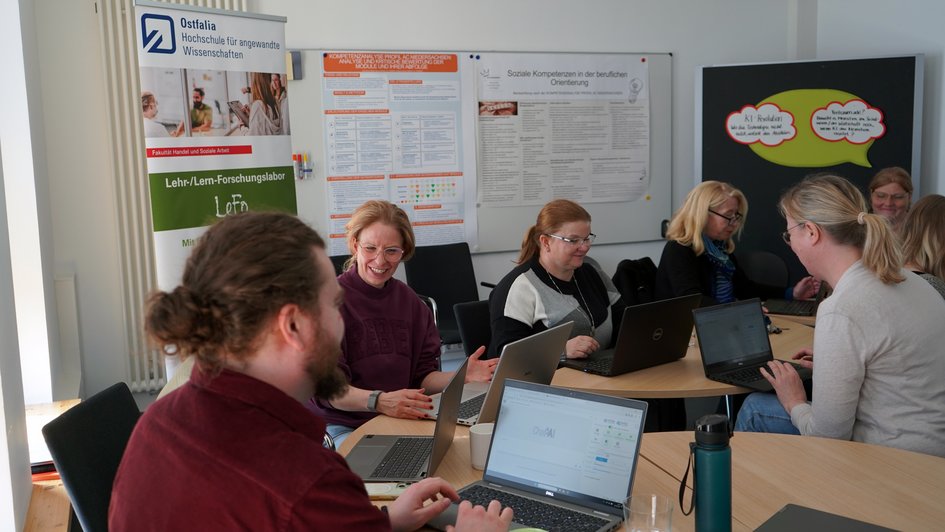
A particular strength of the format was the diverse composition of the participants: Students, administrative staff and teaching staff worked together on issues relating to the use of AI. This interdisciplinary exchange enabled different perspectives on the use of ChatAI and promoted a particularly practical and lively dialogue.
At the beginning, the participants were given a clear introduction to how AI systems work. The focus was on the role of so-called prompts - i.e. targeted inputs with which users influence the output of the AI. It became clear that not only the clarity of content, but also the structure, context and objective of a prompt are decisive for the quality of the results generated.
Strategies for effective prompting
The workshop also highlighted various strategies that can be used to further optimise AI output. These included the gradual refinement of queries, the definition of specific roles for the AI, the specification of styles and working with examples. Technical backgrounds and existing limitations were also discussed in order to convey a realistic understanding of the possibilities and limitations of AI applications.
Trial phase at the AI Get Together
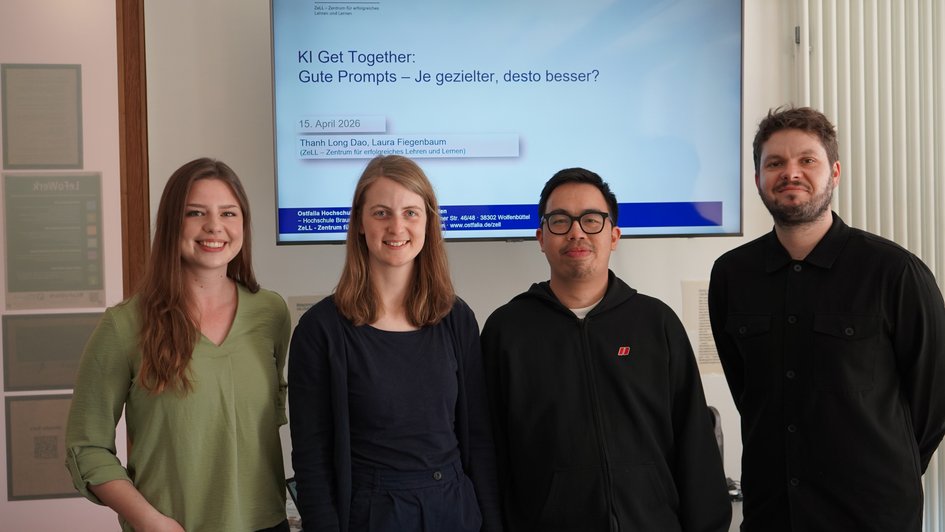
In the subsequent trial phase, the participants were able to directly apply what they had learnt. Using their own or provided devices, they experimented with different prompt variants and shared their experiences. They were accompanied by Laura Fiegenbaum and Thanh Long Dao from the Centre for Successful Teaching and Learning (ZeLL), who provided additional perspectives on creative and targeted writing with AI.
Prompting is becoming a key skill
Organiser Laura Risse emphasised the relevance of the topic: "The ability to prompt is becoming increasingly important both at university and in professional life. During LeFOpen, the joint, independent experimentation across disciplines and status groups also highlighted the great potential for mutual learning - in the sense of co-constructive work."
Prompting combines several future skills: analytical thinking, clear communication and the ability to use digital tools sensibly. It enables complex tasks to be solved efficiently, creative processes to be supported and information to be processed in a targeted manner - skills that are increasingly in demand both in academic studies and in the modern working world.
About the LeFo at the faculty
The LeFo is the social work laboratory at the faculty and offers a unique environment for research-based learning, peer-to-peer exchange and the practical development of socio-educational skills.