

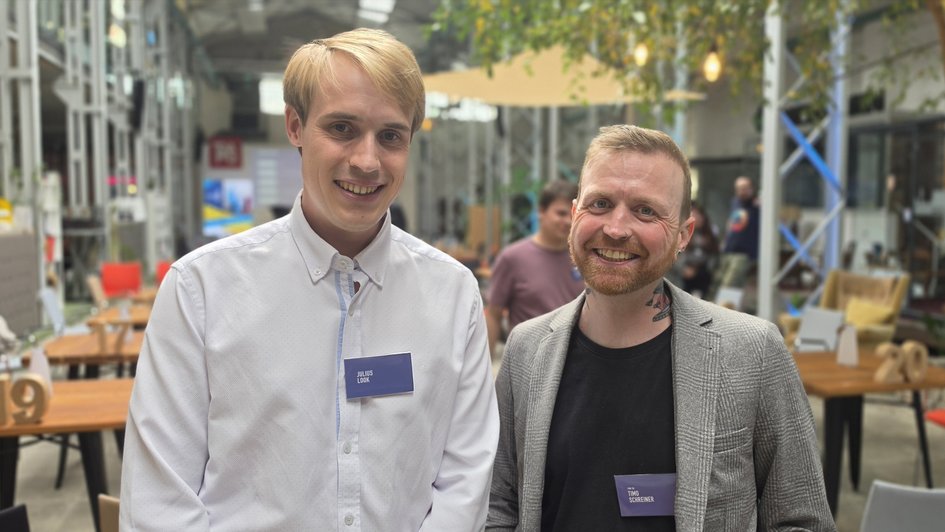
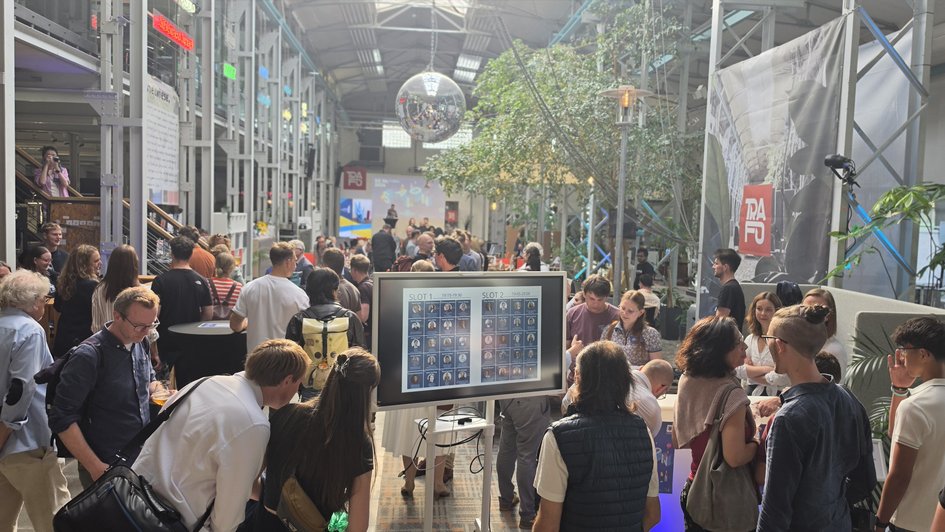
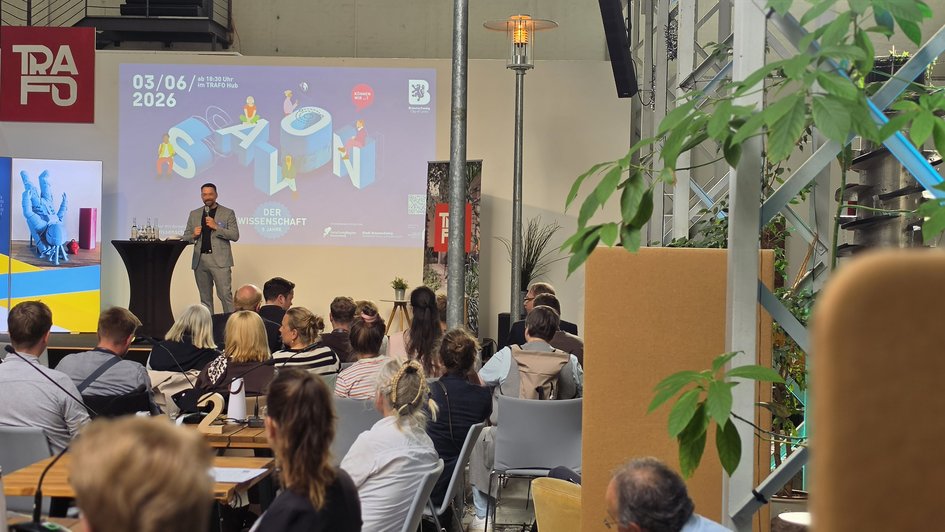
How does it feel to explain your own research directly to curious members of the public in a one-to-one conversation? At the "Salon of Science" at the TRAFO Hub Braunschweig, two researchers from Ostfalia University were able to experience this several times. In three slots of 15 minutes each, Julius Look and Timo Schreiner sought dialogue with the guests. Their topics on early infection detection in wastewater and good education between everyday life and research met with broad interest.
Wastewater as an early warning system: sewer detectives in action
Under the title "How do sewer detectives track down germs?", Julius Look, research associate at the Centre for Hydrosystems and Health (CHH) at Ostfalia, gave insights into research into wastewater analysis as an early warning system for infections. The research team is working on developing a fast, cost-effective and easy-to-use method that can be used to obtain information on urban infection hotspots from municipal wastewater. To this end, the researchers are developing special samplers, optimising the sampling locations using artificial intelligence and analysing which bacteria and resistance genes are found in the samples.
"Many visitors were surprised at how much information we can derive from wastewater," reports Look. "In one-on-one discussions, we were able to talk very directly about how such data can help to detect outbreaks earlier or deploy resources more effectively, for example in the healthcare sector." Of course, there was also a bit of excitement before the format, but after the first round, Julius Look was already certain: "It's cool, great concept."
Good education between everyday life and science
Timo Schreiner, Professor of Child and Youth Welfare at the Faculty of Social Work at Ostfalia, also focussed on everyday life. His table discussions focussed on how everyday experiences, values and scientific findings interact in parenting. "In everyday life, parents and professionals often experience parenting as something very intuitive - characterised by their own experiences and cultural norms," explains Schreiner. "Educational research offers models and theories that help to describe, categorise and critically question these actions."
It was precisely at this interface that the dialogue in the Salon der Wissenschaft began: How can professionals act professionally when everyday practice and research findings are not always congruent? What role do unconscious routines play? And how can scientific findings be translated in such a way that they can actually be used in everyday family or daycare centre life? Schreiner really enjoyed the format: "I'm really pleased that there is such an honest interest in my topic. That people really want to know what the theories are behind pedagogy in everyday life."
Salon of Science: dialogue format with diversity
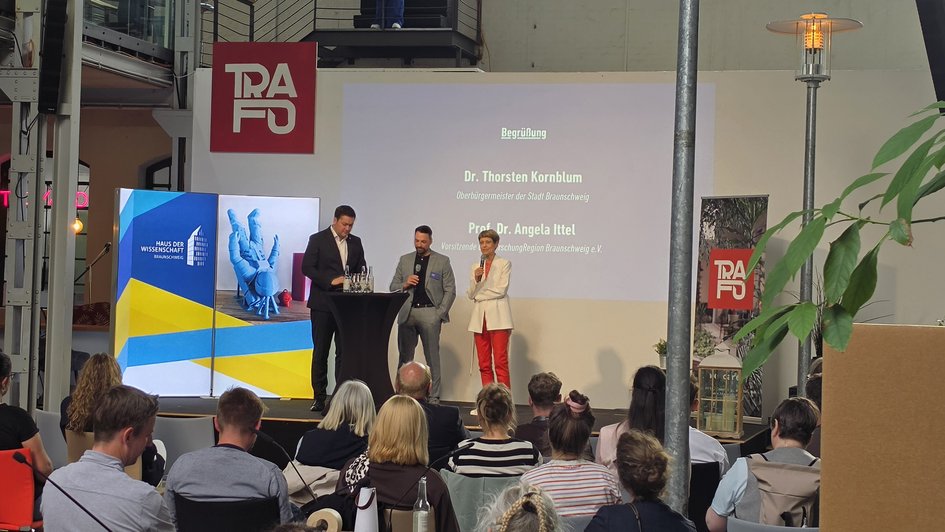
The "Salon der Wissenschaft" (external link, opens in a new window)is a format developed by the Haus der Wissenschaft Braunschweig and is organised by the ForschungRegion Braunschweig e.V. association together with the city of Braunschweig. The format deliberately sees itself as an event that brings together scientific institutions and urban society at eye level and shows the wide range of research in the region. Around 30 researchers from various institutions and disciplines discussed topics such as biodiversity, digitalisation, climate protection, health and culture with the guests.