
Project goals and partners
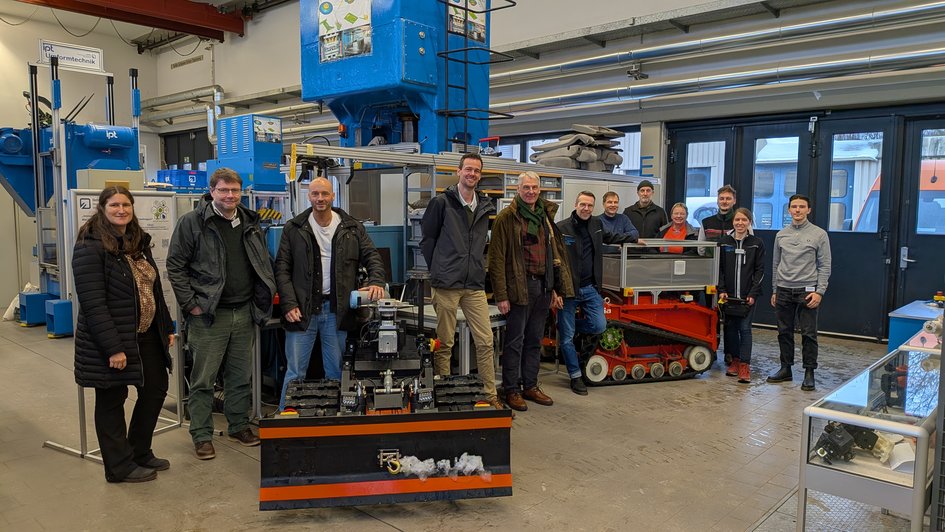
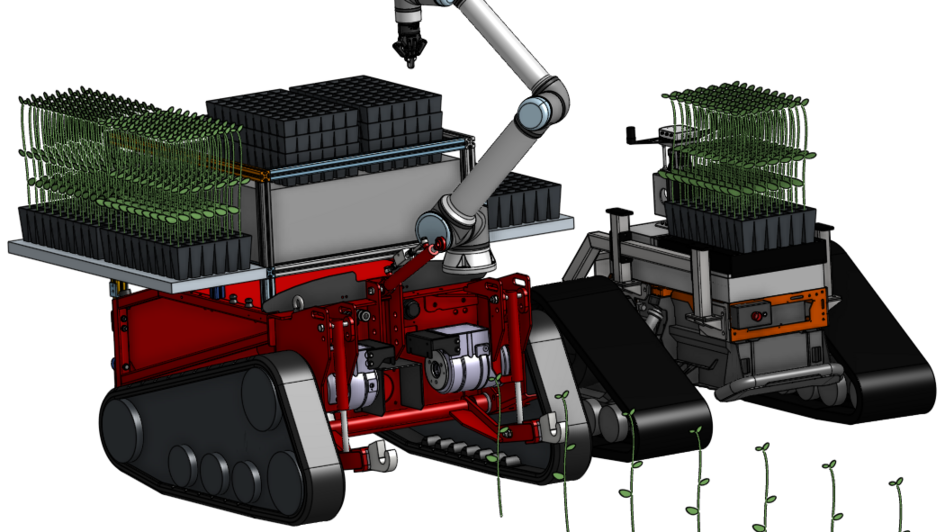
The Faculty of Mechanical Engineering at Ostfalia is developing an automated reforestation process in collaboration with the University of Applied Sciences and Arts Hildesheim/Holzminden/Göttingen (HAWK Göttingen) and the Lower Saxony Chamber of Agriculture. Two all-electric, all-terrain, autonomous mobile robots (AMR) will work together in a swarm of machines and plantseedlings1 on forest areas damaged by climate change using a newly developed planting unit1.
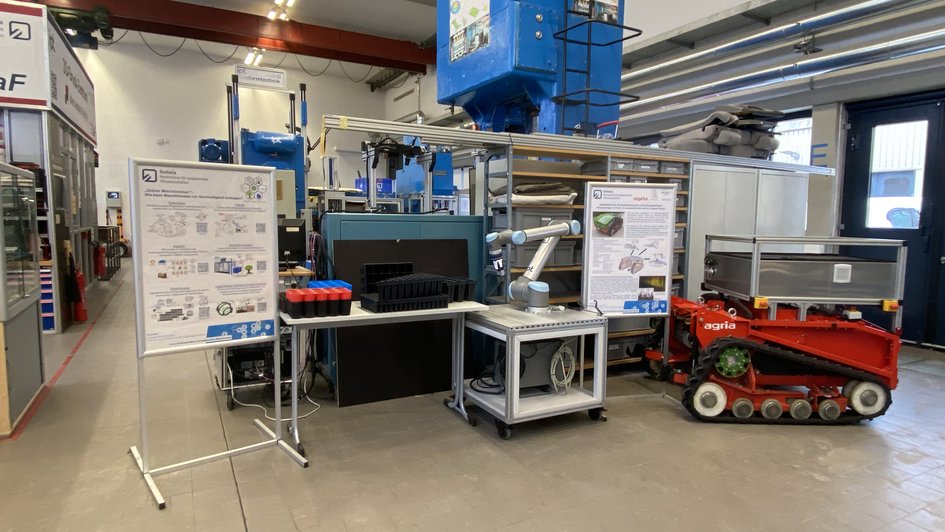
Sub-goals of the project are the prototype of a special planting unit as an attachment and an industrial robot adapted to harsh environments on a mobile platform, which carries out the various handling tasks with different seedlings. Open-system software ensures that the two AMRs find their way around the forest using sensors such as LiDAR2 and camera systems and that the concept can also be transferred to other applications.
The practical implementation is taking place on forestry trial areas in south-east Lower Saxony. State and private forest owners are involved in the project as associated partners.
Interview on the project with Professor Ligocki
Ostfalia Professor Dr Andreas Ligocki from the Faculty of Mechanical Engineering provides in-depth insights into the project in a short interview.
Vera Huber, Ostfalia Editorial Team: The ForestBots project is about automated reforestation processes. How do the robots interact with each other?
Prof Dr Andreas Ligocki: The two caterpillars communicate via a very fast WLAN - comparable to the technology in a house. However, as they have to exchange large amounts of data, stability and speed are extremely important - so the 5G mobile phone standard would be helpful here. As there is no Wi-Fi and usually no mobile network in the forest, we create our own network with the help of a radio mast. We already have similar ones in use in other projects3. For this project, we will be setting up a special third mast, which will then receive the special, fast WLAN.
You are also working with a newly developed planting unit. What characterises this unit and what is new about it?
Prof Dr Andreas Ligocki: The unit doesn't exist yet, we are developing and building it. This is one of the core tasks of Anja Krauth, who is involved in the project as a research assistant at the Faculty of Mechanical Engineering. The unit is characterised by its modular design and the fact that it can also be attached to other carrier machines such as a tractor or another caterpillar at a later date via a so-called standard interface, i.e. a three-point linkage. The unit must be both robust and lightweight so that it a.) fulfils the requirements in the forest and b.) can also be moved, e.g. lifted, by our small forestry tractor.
Industrial robots make planting work possible even in areas that are difficult for humans to access. What exactly does this mean and what significance does it have for nature conservation and forestry?
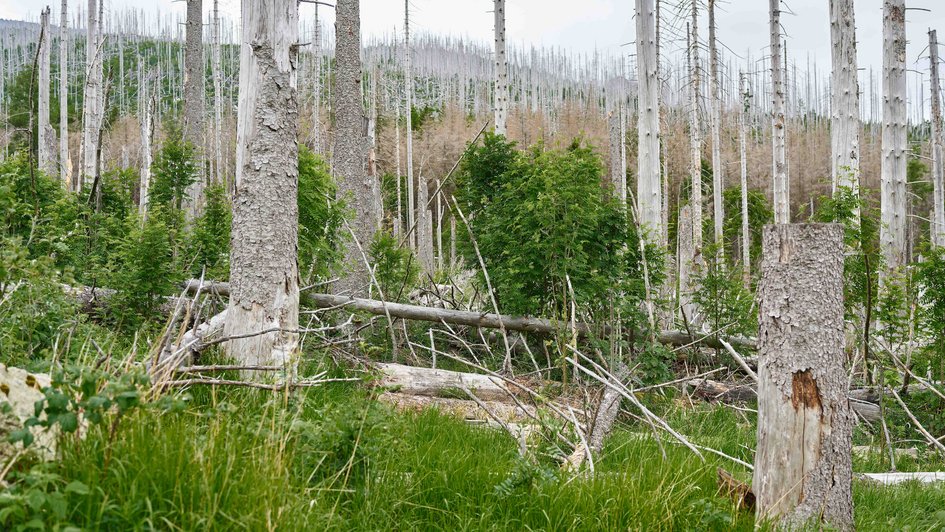
Prof Dr Andreas Ligocki: Calamity areas4 must not be entered by humans in some cases because there is a risk of death from dry falling branches due to the drying or dead stands. This is where our two caterpillars and the special industrial robot are supposed to work. As our machines are so small and run on caterpillar tracks, the ground pressure is very low. This minimises damage to the land and soil compaction. This is a completely different approach to the one usually taken with large forestry machines. These weigh up to 40 tonnes. Our machine weighs less than 1 tonne, and they run on tracks, not wheels, so the low load is applied more evenly than tyres.
People used to work with horses in the forest. Occasionally this is still done today. Our system is very environmentally friendly and can also be used in nature reserves under certain circumstances thanks to the fully electric drive. Perhaps the caterpillars are even a little more environmentally friendly here than using horses!
What developments do you expect for this technology after 2027?
Prof Dr Andreas Ligocki: Basically, swarm technologies are becoming increasingly interesting in agriculture and forestry because the large, heavy machines are reaching a wide variety of limits. In addition, soil compaction must not increase any further. That is a decisive criterion.
We cannot present a definitive solution with this two-year project, but we hope for appropriate follow-up funding and would like to push ahead with off-highway robotics5. We see enormous potential here. That is why our project is one of the few to be funded in this funding line.
Funding and project duration
The ForestBots project is being funded by the Federal Ministry of Research, Technology and Space (BMFTR) as part of the "Digital GreenTech - Environmental Technology Meets Robotics" funding guideline with 1 million euros6 and will run until the end of 2027. The Karlsruhe Institute of Technology (KIT) is the project sponsor. Researchers from the Faculty of Mechanical Engineering at Ostfalia University of Applied Sciences specialising in robotics (Prof. Dr Holger Brüggemann) and mobile machine design (Prof. Dr Andreas Ligocki) as well as researchers from HAWK Göttingen (Prof. Dr Thomas Linkugel) in the field of embedded systems and from the forestry division of the Lower Saxony Chamber of Agriculture are involved in the project.
Due to the continuously changing climatic situation in conjunction with the shortage of skilled labour in forestry, the robot swarm offers an opportunity for large-scale, mechanised reforestation that is also safe for humans.
Explanations to the text:
1) Planting units are attachments for excavators or tractors. They can be used to efficiently place containerised plants in the ground during reforestation measures
2) Light Detection and Ranging: laser-based remote sensing technology for precise 3D detection of distances and environments in real time
3) See here
4) Large areas of forest damaged by storms, pests or other factors
5) Use of autonomous or remote-controlled robotic systems and intelligent machines outside paved roads, especially in unstructured environments
6) Funding reference: 02WDG1760A