

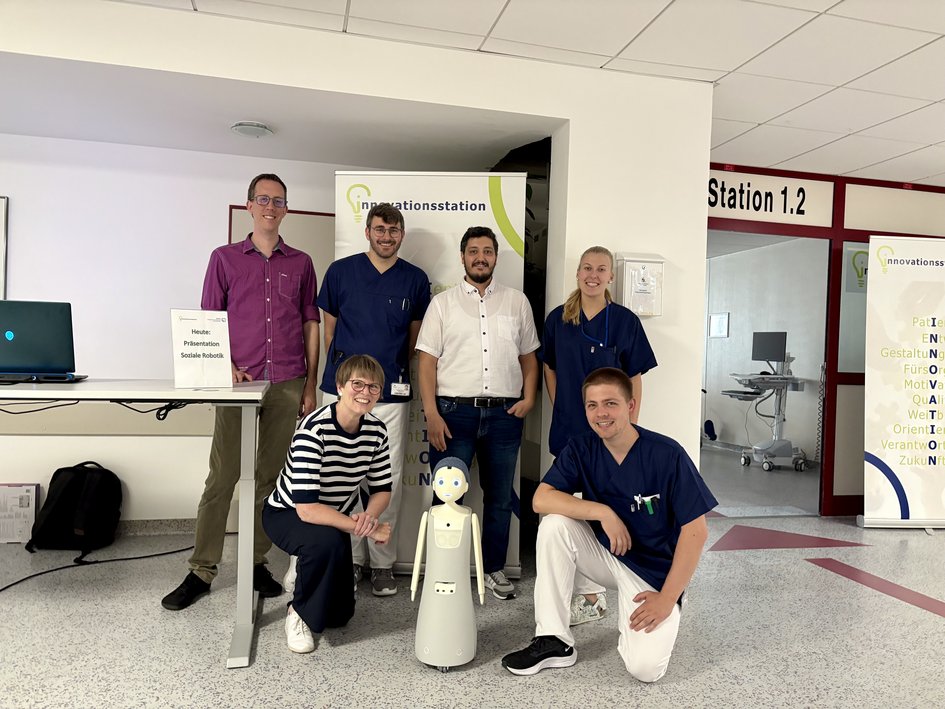
Small but mighty: Momo the social robot recently paid a visit to Wolfenbüttel Hospital. Together with the hospital’s Innovation Unit, Prof. Dr.-Ing. Dagmar Meyer, research assistant Faycal Nait Irahal (both from the Faculty of Electrical Engineering and Information Technology) and Prof. Dr Tobias Dörnbach (Faculty of Computer Science) introduced the little chap to staff, patients and visitors. Guests were able to experience Momo for themselves, strike up a conversation with him and find out about potential applications in everyday hospital life. The information day also provided an opportunity to incorporate practical ideas into future research.
Cooperation between the university and the hospital
Through this event, Wolfenbüttel Hospital and Ostfalia University aim to further expand their collaboration in the field of social robotics. “We would like to cooperate more closely with the hospital and, in particular, with the Innovation Unit,” says Prof. Meyer. The Innovation Unit aims to regularly introduce staff to new developments in nursing and medical care. “The idea arose from a joint research proposal to provide information on our activities in the field of social robotics on site from time to time.”
Positive feedback and plenty of new ideas
The response to Momo was consistently positive. “People found Momo fascinating and enjoyed chatting to him,” reports Meyer. Only a few were initially somewhat reserved and preferred to observe. However, nursing staff and nursing students in particular immediately recognised the robot’s potential. “They also had immediate ideas about what else could be achieved.” Singing was right at the top of the wish list. Communication in foreign languages and the translation of explanations were also mentioned as useful applications. “We’ve already discussed this today in my team,” says Meyer.
Relief in everyday hospital life
From the researchers’ perspective, a social robot could provide support in many areas of everyday hospital life in the future. Handling general information tasks is seen as particularly promising. Meyer: “Momo could answer simple questions on non-medical topics, such as: ‘What’s on the menu?’ or ‘When is the kiosk open?’” This would help relieve the burden on hospital staff in their day-to-day work.
Meyer also sees great potential in the robot acting as a wayfinding aid. During the information day, several people had been looking for a diagnostics department that had been relocated due to building works. “A robot could even guide these people to their destination.” Furthermore, Momo could provide relatives with general information and offer them guidance in a stressful situation. “Anxious relatives, who may not have immediately understood what is wrong with the person admitted or what is going to happen next, could be reassured and given detailed information through a conversation with the robot.”
Inspiration for research
The discussions with hospital staff provided the research team with numerous ideas for the further development of social robotics. “The great interest and positive feedback from hospital staff were fantastic. The numerous discussions provided us with plenty of new ideas for continuing our research activities,” summarises Meyer.
She also highlights the collaboration with the hospital as particularly positive: “The hospital’s great openness to new ideas and the wonderfully straightforward collaboration are definitely worth mentioning.”