

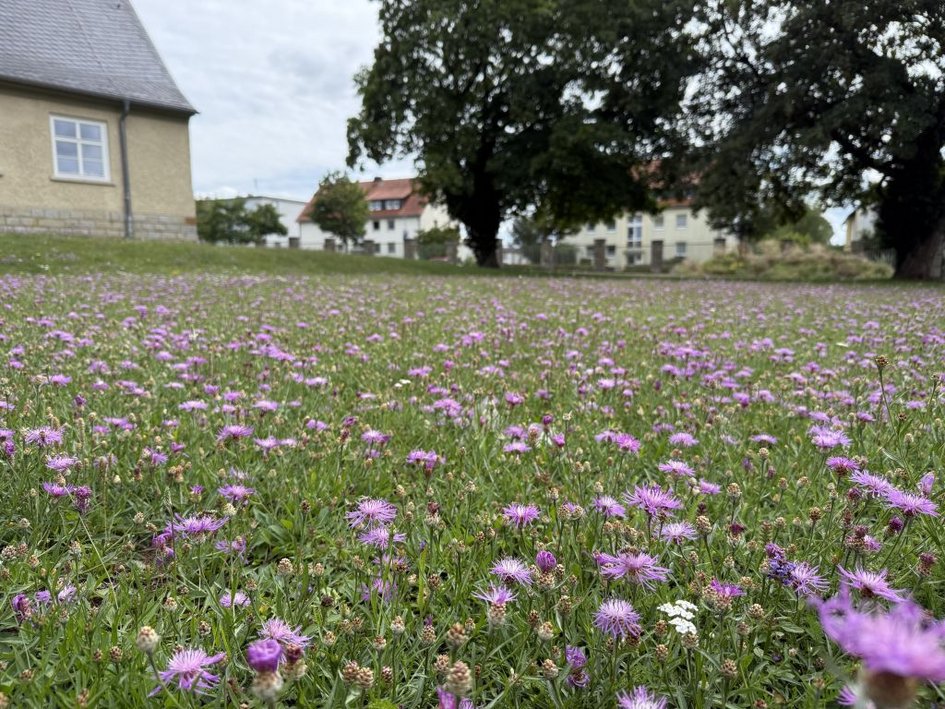
The green spaces on the Am Exer campus and in the forest garden managed by BUND are far more than just open spaces. If you take a moment to look more closely, you will discover a species-rich habitat with an impressive variety of native wild plants. These include, amongst others, common brownel, yarrow, meadow knapweed, ribwort plantain and numerous grasses. Together, they provide a rich array of flowers from spring through to autumn and form the basis for a functioning ecosystem.
Green spaces provide food for insects
Appropriate management of green spaces allows the plants to flower and set seed. This helps to preserve biodiversity in the long term and safeguards the habitat for numerous animal species. The meadow flowers provide food for wild bees, bumblebees, butterflies and many other pollinators. The plants also provide suitable habitats for beetles, grasshoppers, spiders and other small creatures. These, in turn, form the food source for various bird species and bats.
As a result, species such as the green woodpecker, great spotted woodpecker, black redstart, serin, warblers, goldfinches and many other bird species can be observed on campus and in the woodland garden. The green woodpecker benefits from the insect-rich meadows, where it mainly finds ants, whilst the black redstart uses open green spaces and buildings as breeding and hunting grounds. Together with the old trees, hedges and shrubs, the Exer provides a diverse habitat for a wide variety of native animal species. In the woodland garden at the Exer, you can always find a shady spot to rest and relax, even on warm days. As well as a garden area and a large orchard meadow, there are plenty of cosy corners here to linger in.
It’s definitely worth taking a closer look!
Info: Why doesn’t the grass in the meadow grow as tall as it does in the woodland garden?
Many people associate a species-rich meadow with tall grass and lots of colourful flowers. In fact, the opposite is often true: the meadows at the Exer grow relatively short because the soil is low in nutrients and the areas are not heavily fertilised. Under these conditions, many different wildflowers and herbs can thrive without being outcompeted by a few particularly vigorous grasses.
In nutrient-rich areas, on the other hand, grasses grow very quickly and form dense stands. Many flowering plants then receive too little light and gradually disappear. A low-growing meadow can therefore be particularly rich in species.