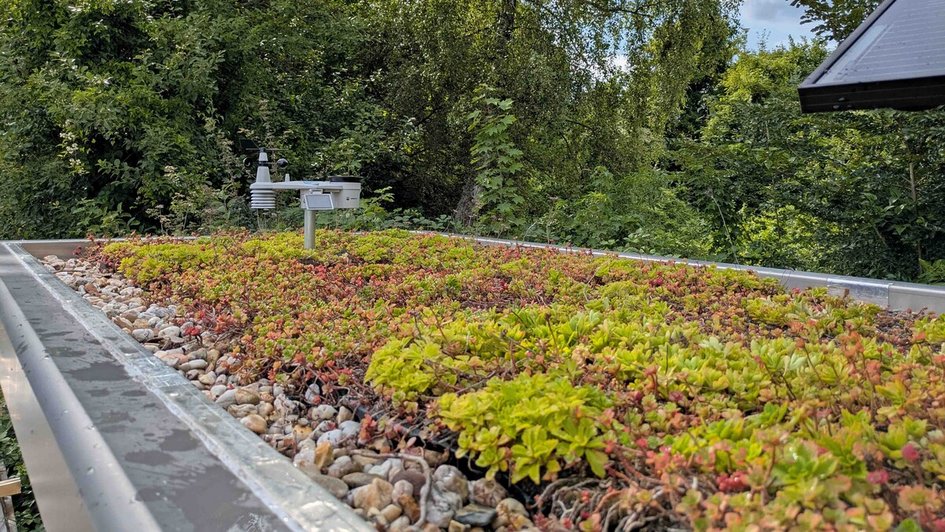

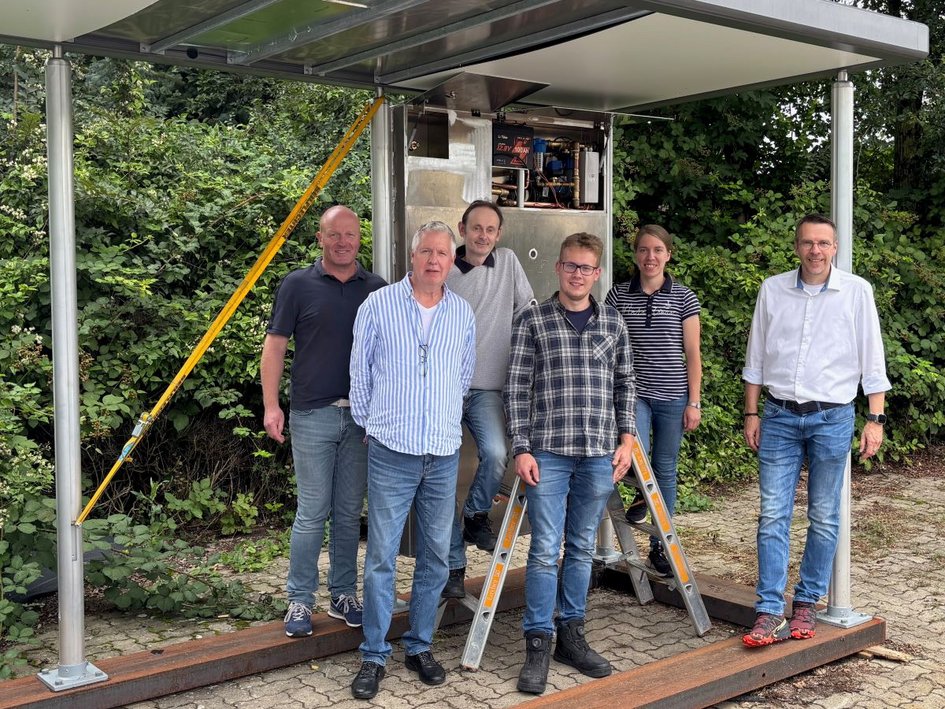
Green roofs have a positive effect on the local climate and water balance. Some bus shelters already have green roofs. Without irrigation, however, the plants dry out in extreme weather conditions - the positive effect is lost. Ostfalia University is now working with an industrial co-operation partner to develop a self-sufficient irrigation system for green bus shelters. A component with a water tank and technology replaces the rear wall of the bus shelters - ideal for retrofitting.
System consisting of water tank, sensors and control unit
Municipalities and cities take great care of their trees and green spaces to counteract climate change. Plants in beds, tubs or on roofs promote biodiversity, bind CO₂, convert it into oxygen, cool through evaporation and filter fine dust from the air - thereby improving air quality and the microclimate. Green roofs also store rainwater and relieve the burden on the sewerage system. But the maintenance effort is high. During dry periods, street trees and green spaces have to be watered, which is labour-intensive and time-consuming. Inadequately maintained green roofs often dry out in hot weather or flood during heavy rainfall - the positive effect is lost. Ostfalia University of Applied Sciences has been researching intelligent irrigation technology for urban green spaces, including sensor technology and communication management, for some time.
Storing water, supplying green roofs as required
The "SmartCity Irrigation" project is now putting research solutions for self-sufficient irrigation into practice. "The company Hohrenk Systemtechnik GmbH became aware of our prototype of an autonomously irrigating park bench and initiated the joint project," explains Prof Dr Andreas Ligocki from the Faculty of Mechanical Engineering. Among other things, Hohrenk Systemtechnik GmbH equips bus stops with bus shelters, which are widely used in the Wolfenbüttel region. Ten bus stop shelters with self-sufficient irrigation are now planned. Five of them will have green roofs, while five others will supply water to nearby green spaces or trees - the typical village oak - within a radius of up to 25 metres from the bus shelter. The Faculties of Mechanical Engineering and Computer Science at Ostfalia University are providing the environmental sensors and digital technology and measuring the microclimate.
"The rear wall of the bus shelter is replaced by a structural element with a water tank and technology," explains Andreas Ligocki, "which is simply ideal for retrofitting." Sensors monitor the fill level and soil moisture, and a pump feeds water into the roof substrate or the green area as required. The control system takes weather forecasts into account and regulates water consumption to conserve resources. A solar panel with battery storage supplies the sensors, pump, controller and digital components if there is no power connection available. The fill level, climate and status data are transmitted to the local authority via a wireless network (LoRaWAN). Rainwater can be stored in the substrate and tank, with any surplus being channelled into the sewer system with a time delay. If the water level drops without any foreseeable rainfall, a water lorry is automatically requested from the local authority to refill the tank.
First sample waiting rooms in test operation
In the long term, Hohrenk Systemtechnik GmbH also wants to integrate the system into newly manufactured bus shelters and is testing an underground tank solution in the foundations. But how robust and maintenance-intensive will the green roofs and irrigation systems be? "We use inexpensive standard components and proven green mixtures," answers Andreas Ligocki. "Steel tanks and stable walls should protect against vandalism." The first sample shelters are currently being tested. The cooperation partners are gathering important experience with the pilot series, for example how leaves and blockages affect the water hoses. "The radio connection tells the local authorities whether they need to refill the water tanks if necessary," he adds.
"We are actually very proud of this transfer of research into practice with a medium-sized partner," confirms Andreas Ligocki, "because we believe we are hitting the nerve of the times in hot city centres." Project partner Hohrenk plans to independently offer new bus shelters with self-sufficient irrigation technology and innovative retrofit systems in the future. The transfer project is funded by the "Unternehmen Revier" programme and the Federal Ministry for Economic Affairs and Energy. The ten planned model bus shelters will be built in the Wolfenbüttel, Helmstedt, Braunschweig, Wolfsburg and Salzgitter regions by 2026.