
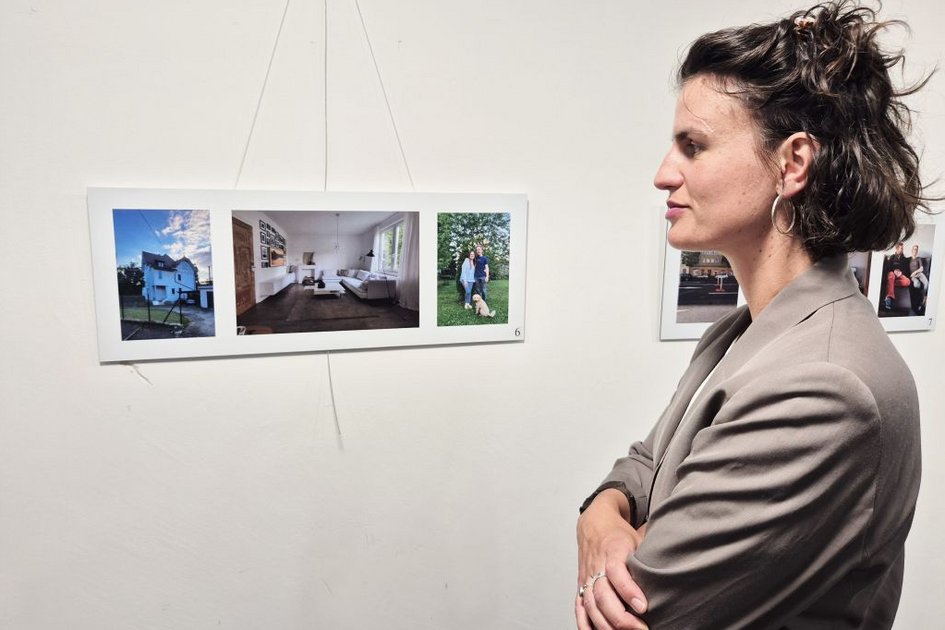
The exhibition "Making Classism Visible", which is being shown at Ostfalia as part of Diversity Day (19 May 2026), first made a stop at the Wolfsburg campus and can now be seen at the Suderburg campus. The photo series developed by sociologist Magdalena Bausch as part of a research project is based on Pierre Bourdieu's study "The subtle differences" and makes social inequality and classism tangible through staged visual worlds. Homes, interiors and portraits are juxtaposed in such a way that they visualise everyday attributions and prejudices. The exhibition invites visitors to question their own patterns of perception and to critically reflect on the mechanisms of social categorisation.
The exhibition was organised by a cross-university preparatory group from the areas of equal opportunities, diversity, staff development and teaching. It includes Kyra Jantzen (decentralised Equal Opportunities Officer at Faculty G in Wolfsburg), Yvonne Neuse (Learning Coaching Suderburg), Caroline Haubold (Human Resources Development, Health Management and University Sports), Timo Schreiner (Diversity Officer and Professor of Child and Youth Welfare at the Faculty of Social Work in Wolfenbüttel) and Regina Schwichtenberg (Equal Opportunities Office).
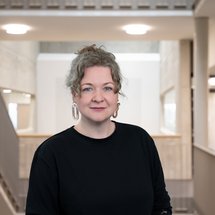
We spoke to Kyra Jantzen, decentralised Equal Opportunities Officer at the Faculty of Health, and asked her a few questions.
Britta Radkowsky, Ostfalia editorial team: What makes the "Making Classism Visible" exhibition particularly relevant in the university context?
Kyra Jantzen: As an educational institution, a university is a place where social equality and inequality are reproduced. On the one hand because access to higher education is regulated, on the other hand because we open or close doors for professional development with the degrees we award.
At the same time, universities speak their own language. There are 'hidden' rules that are not communicated transparently. These 'codes' sometimes exclude people who have had no contact with this language and these rules in their previous lives. This makes it difficult for some students to find their way around the university and feel like they belong. A large group of these students are 'first generation students', i.e. all those students who are the first in their family to start a degree programme.
The exhibition 'Making Classism Visible' can provide a framework in which we can reflect on which everyday images we are used to, which we are less used to, what we understand as 'normal' against this background and where we overlook and fail to think about the reality of life other than our own as a result of this habit.
The photo series deliberately plays with our spontaneous attributions: What do you want visitors to learn about themselves by looking at them?
Kyra Jantzen: The exhibition can allow us to experience how quickly we make judgements about a person's social position. From this point, we can start to think about how these judgements shape our thoughts and actions.
Classism is often discussed less visibly than other forms of discrimination. Why is it important to focus more on this topic?
Kyra Jantzen: We agree that classism sometimes receives little visibility. Perhaps also because it is not so easily 'visible'. However, we all position ourselves in society, have different resources at our disposal and make our decisions based on the logic of our own position. If we do this as a university without reflection, it means that we exclude many smart people from our institution because we make access very difficult. At the same time, we quickly create the impression that our own social position is the result of our own decisions. Thinking about classism can help us to understand that the way we grow up has a huge influence on which doors open for us in the course of our lives and why some doors remain closed.
The exhibition was first in Wolfsburg and has now moved on to Suderburg - what significance do such cross-location formats have for gender equality work?
Kyra Jantzen: In addition to the exhibition venues in Wolfsburg and Suderburg, we are also creating the opportunity for digital participation with the hybrid exhibition opening on 28 April 2026. On the one hand, we want to enable as many people as possible to see the exhibition. At the same time, this cross-location work also means that we at Ostfalia see it as part of our mission to make the diversity of life realities visible and to assume social responsibility.
As in Wolfsburg, there will also be a Gallery Walk in Suderburg: What can participants expect and how can this tour change the way they view the exhibition?
Kyra Jantzen: TheGallery Walks offer the opportunity to reflect on your own impressions together with a group, ask questions and engage in dialogue. They offer the opportunity to delve a little deeper into the topic of classism and can invite you to find your own approach to the pictures.
Exhibition times and events
19.05 - 29 May | Suderburg | Building G, Mensa foyer | Herbert-Meyer-Str. 7
27.05, 12:15 p.m. Impulse lecture and gallery walk with Professor Dr Jörg Plöger
Background information
An insight into the work of Magdalena Bausch can be found in the programme on Baden TV Süd (external link, opens in a new window).
In his study "The subtle differences", the French sociologist Pierre Bourdieu examines social differences by analysing taste, which he understands as internalised imprints and an expression of people's social background. According to Bourdieu's theory of capital, a person's social position, success and influence are largely determined by the accumulation and embodiment ("incorporation") of different types of capital. In addition to economic capital, this also includes cultural, social and symbolic capital. The different types of capital can intertwine, reinforce and also be transformed into one another. On the basis of the concept of habitus, which Bourdieu conceives as internalised and embodied capital, he describes and analyses the shaping and transmission of the social position of individuals over generations through social origin.