
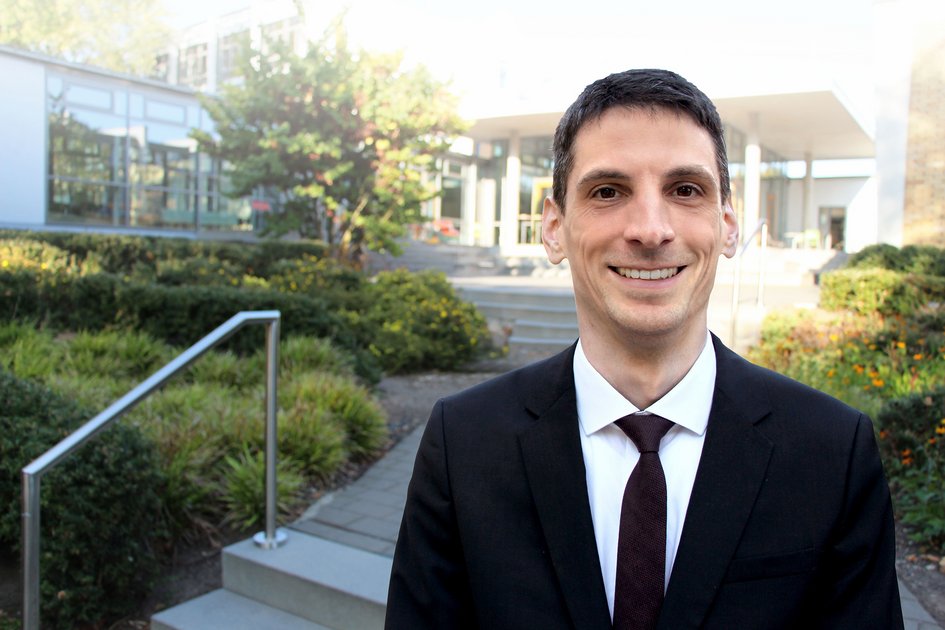
Highly topical subject: Prof. Dr Udo W. Becker from the Faculty of Law - Brunswick European Law School (BELS) will be giving a lecture on "Sustainability on the brink: Trump's doctrine strikes back?" at the third Wolfenbüttler Klimaforum on 16 April 2026 on the Ostfalia campus on Salzdahlumer Straße. We asked him a few questions in advance.
Britta Radkowsky, Ostfalia editorial team: How would you describe the central conflict of objectives behind debates on sustainability and "Trumpian" policies?
Prof Dr Udo W. Becker: On the one hand, there are scientific realities. The scope of climate change and the intensity of its effects can be discussed at the margins. However, it makes little sense to dispute climate change as a whole and its impact on future generations. Scientific realities are not opinions.
On the other hand, there is the desire to satisfy human needs at the lowest possible cost. This is not incomprehensible, especially from the perspective of the current generation: free development, energy security and social stability are legitimate concerns.
Economic benefits vs. long-term goals
Why do short-term economic benefits often appear politically more attractive than long-term sustainability goals?
Prof Becker: This is mainly due to who benefits from these advantages and disadvantages. Benefits that can be achieved in the short term affect current generations. Long-term disadvantages primarily affect future generations. Only the current generation chooses and makes decisions. It therefore depends on their benefit preference. Of course, the current generation also cares about the well-being of future generations, but it also cares about its own well-being.
Where do you see legitimate criticism of an ambitious sustainability policy - in other words, points that cannot simply be dismissed out of hand?
Prof Becker: Legitimate criticism is directed less against the "whether" of climate protection and more against the "how". For example, one can question whether the more or less arbitrary declaration of individual branches of industry, such as nuclear power or natural gas, as "sustainable" under the EU Taxonomy Regulation makes sense. For example, the question of the sustainability of nuclear power will be answered differently in France than in eastern Lower Saxony.
"The market should decide what is sustainable"
Are there examples where this conflict of objectives has already been successfully defused or resolved?
Prof Becker: The market should decide what is "sustainable". If you don't have to pay for petrol, people will always prefer cars to public transport, at least if you assume economic behaviour. You do not internalise the fuel costs. It is similar with climate protection: if you don't have to pay for polluting the environment, you will pollute. However, given the political will, the costs could be internalised, be it through a so-called Pigouvian tax or CO2 certificate trading. It would be possible to put a price tag on pollution so that only those who expect to benefit most from it pollute.
What role do international co-operations play here, and what happens if major players pull out of such agreements?
Prof Becker: The measures mentioned only work if everyone participates. If individual (major) players drop out, the system collapses: If a European company has to pay for pollution, but a US company does not, this creates a competitive disadvantage that can hardly be communicated.
Problem in the debate: society is polarised
What narratives or misunderstandings make an objective debate about this conflict of objectives particularly difficult?
Prof. Becker: One major problem is the polarisation of society. It is almost impossible to discuss sensible and less sensible measures if, on the one hand, climate change is defiantly labelled a "hoax" and, on the other, any criticism of individual measures is condemned across the board with a raised index finger.
Where do you see the greatest leverage for change, in politics, in the economy or in the behaviour of society?
Prof Becker: On the one hand, the question is which procedures are most likely to be socially accepted. Marketable procedures such as those described above will always have an acceptance advantage over bans. Making petrol more expensive is different from banning private transport. At the same time, marketable processes promote the pressure to innovate, for example by producing with lower CO emissions.
At a glance: the presentations at the Climate Forum
The Climate Forum combines education, research and commitment in an open event format. Starting at 2 p.m., entertaining and informative keynote speeches will shed light on current topics from science, business and society - from sustainable consumption and innovative building technology to modern production and resource utilisation. The presentations will take place in the Ostfalia auditorium.
- 14:00 to 14:25: Marketing, consumption and climate change (Prof Dirk Hohm)
- 14:30 to 14:55: Sustainable teaching in times of AI - a field report based on the laboratory-based brewing of beer(Prof Thorsten Ahrens)
- 15 to 15:25: The science behind modern buildings: smart heating, smart cooling, sustainable construction(Prof Lars Kühl)
- Break
- 16 to 16:25: From self-watering bus shelters to climate cubes - how modern mechanical engineering addresses green issues(Prof. Andreas Ligocki)
- 16:30 to 16:55: Utilisation of residual and waste materials(Prof. Elke Wilharm)
- 17 to 17:25: Sustainability on the brink: Trump's doctrine strikes back? (Prof. Udo W. Becker)
Eckart von Hirschhausen will speak afterwards
The day will conclude at 6 pm with a lecture by Eckart von Hirschhausen, doctor, science journalist and TV presenter. Under the title of his foundation "Healthy Earth - Healthy People", he will impressively demonstrate why climate protection also means protecting humanity. Due to limited seating, free tickets will be available at the box office from 5.30 pm; alternatively, you can reserve tickets in advance by emailing nachhaltigkeit(at)ostfalia.de (opens your email program). The reserved tickets will be available for collection in the Ostfalia foyer on 16 April between 2 and 5:30 pm.
The Wolfenbüttel Future Prize will then be awarded for the first time. This honours projects that make an active contribution to sustainability in the district of Wolfenbüttel - for example in the areas of the environment, education, social cohesion, resource conservation or energy. The prize is jointly organised by the city and district of Wolfenbüttel, the Curt Mast Jägermeister Foundation, the Ostfalia University of Applied Sciences and the Asse Future Fund.