

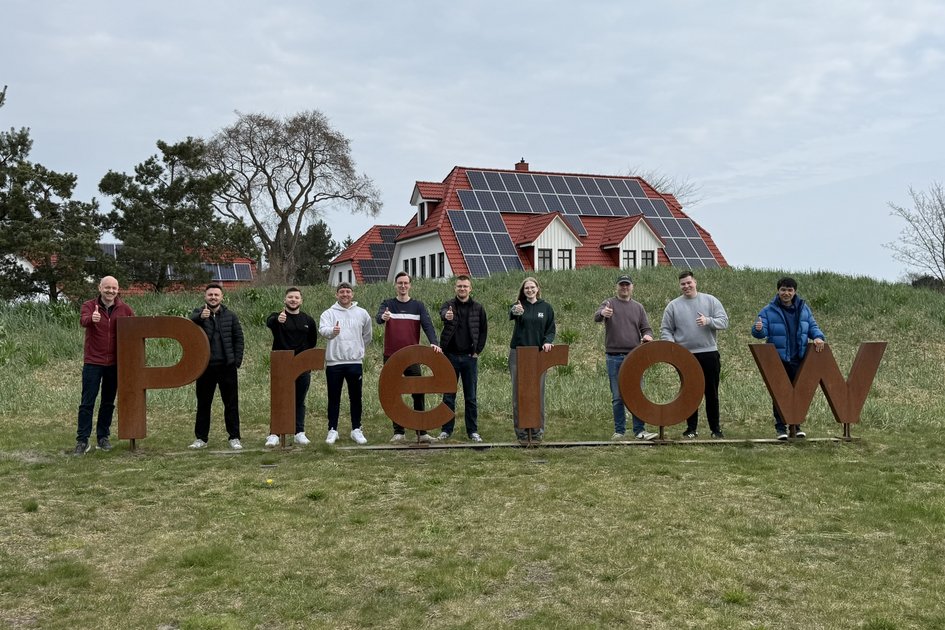
How can traffic flows be managed effectively in a popular holiday resort? This is the question being addressed by 14 students on the ‘Transport and Logistics’ Master’s programme at the Ostfalia Campus in Salzgitter. In the “Ostseebad Prerow 2026” project, they are developing concrete solutions to the seaside resort’s traffic problems.
Prerow has a population of around 1,500 – but during the holiday season, more than 15,000 guests and numerous day trippers arrive. The new pier, in particular, is attracting additional visitor flows. The result: significant strain on the transport infrastructure.
On-site visit with numerous stakeholders
During a stay of several days in Prerow, the students analysed the situation directly on site. Together with representatives from the local administration, tourism, nature conservation and transport planning, existing challenges were discussed and initial ideas examined.
“We were on site and, in discussions with the relevant contacts, identified the key issues in the area of traffic management,” reports student Jonas Bernzen. “Now we are developing more concrete approaches and looking at how the insights we’ve gained can be translated into the best possible solutions.”
Practical learning and taking responsibility
For Prof. Marco Brey, the practical relevance is at the heart of the project. “The students should apply the knowledge they gained during their Bachelor’s and Master’s degrees in a practical way and learn to collaborate with a wide range of stakeholders,” he explains. Particularly in complex projects such as the one in Prerow, it is important to maintain an overview, reconcile interests and systematically develop solutions.
The aim is not to completely rebuild existing concepts from scratch, but to sensibly develop existing structures further. Topics such as traffic management, information systems or the optimal use of existing infrastructure play a central role in this.
Complex tasks
Working on the project also brings its own challenges. “We didn’t know exactly what to expect on site beforehand,” says Jonas. “That showed just how important good preparation is for asking the right questions.”
The multitude of different interests is particularly demanding: “From the local council to the National Park Authority, the Forestry Commission, the Coastal Protection Agency (StaLU), the Transport Authority, the Public Order Office and right down to the visitors themselves, many perspectives need to be taken into account and reconciled.” Added to this is the strong seasonal dynamic: solutions must work both during the peak season and in quieter periods.
Learning from real-life examples
For the students, the project offers valuable practical experience above all. “Direct interaction on site provides a different understanding than pure theory,” says Jonas. “Above all, I’ve learnt how important it is to listen carefully and be well prepared. A real-life example, in other words.”