

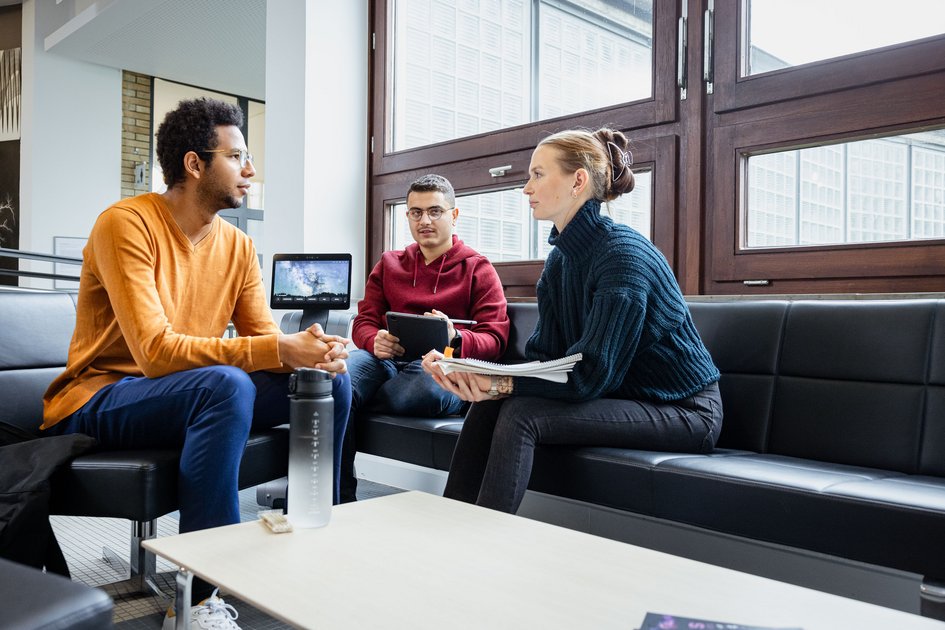
In an ever-changing world of work, continuous professional development has become essential for businesses. But which training programme is right for your team? And how can professional development be effectively integrated into day-to-day working life? Ostfalia University of Applied Sciences offers in-house training programmes to address these needs. This allows the content and scope to be tailored to the specific requirements of each business.
A wide range of topics for every company
Ostfalia’s programme is diverse: it ranges from vocational training specialisms through to sustainability, leadership and change management, right through to disaster management and structural emergency care. The university’s interdisciplinary approach enables training programmes across a wide range of disciplines: business, law, engineering and computer science, social work, healthcare, as well as media and design.
“Currently, topics such as future skills, strategic AI management for executives and pedagogical training for practical instructors – aimed at securing the next generation of talent and improving the quality of training – are in particularly high demand,” says Sandra Hämmerli, who is responsible for academic continuing education in the field of healthcare at Ostfalia. “In addition, new, practice-oriented subject areas are gaining in importance, such as field supervision in the ambulance service and transdisciplinary continuing professional development programmes for emergency care and disaster management.”
Tailored content and formats
In-house training is tailored to the specific needs and requirements of the company or organisation in question. Following a discussion of topics, objectives and framework conditions, lecturers work with the companies to develop a suitable format.
The programme takes place either directly on-site at the company or, alternatively, on campus. Depending on requirements, hybrid or digital formats are also possible. A group size of 12 to 15 people is ideal. “This allows us to create a learning environment that facilitates interactive methods and practical exercises, whilst also providing scope for individual discussion and questions,” explains Hämmerli.
Who are in-house training courses suitable for?
Ostfalia’s in-house training programmes can be flexibly tailored to the respective target group:
- Managers benefit particularly from training programmes that hone leadership skills, explore strategic issues in greater depth or support change processes. These programmes focus on content that has an impact at the decision-making level.
- Entire teams can benefit from collaborative learning formats when the aim is to achieve a uniform level of knowledge or to strengthen teamwork. Joint training sessions create a shared knowledge base and promote exchange within the department.
- Individual departments, on the other hand, often have specific requirements. For example, when new specialist knowledge needs to be deepened or innovative methods introduced that are directly applicable in day-to-day work, in-house programmes offer targeted support.
Benefits for companies and Ostfalia
The greatest advantage for companies lies in the flexibility: the content is precisely tailored to specific requirements. As the training takes place directly on-site, practical examples from the company’s day-to-day operations can be incorporated straight away. Employees can immediately apply what they have learnt to their daily work routines.
Ostfalia also benefits from this format. Through in-house training programmes, the university can apply its knowledge and expertise from research and teaching directly to business practice, thereby strengthening the link between the university and industry. “This also fosters valuable contacts with companies in the region, which can lead to long-term collaborations, joint projects or even new impetus for research and teaching,” emphasises Sandra Hämmerli.
Find the right programme
Interested companies are warmly invited to get in touch. Ostfalia’s Academic Continuing Education department will be happy to advise on the various formats and, on request, develop bespoke programmes.