
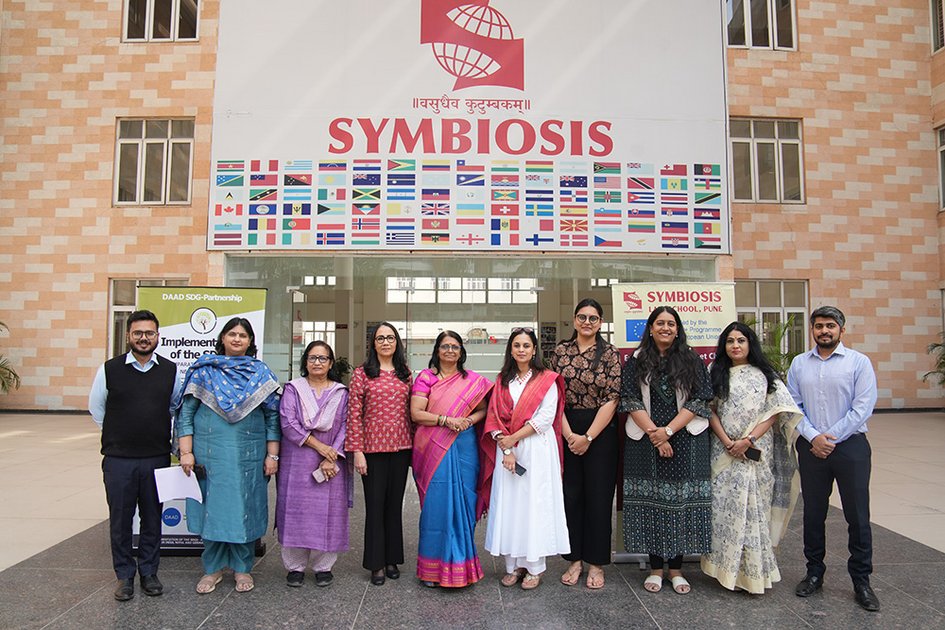
As part of the DAAD–Partnerships-SDG Project: “Implementation of the SDGs: A Comparative Approach in India, Nepal, and Germany,” Dr. Ruth Areli García-León traveled to India to inaugurate the second kick-off meeting of the program at Symbiosis Law School in Pune (SLS-Pune), enhancing international cooperation, academic exchange, and sustainable development efforts.
The activities started with a warm welcome and a presentation of the objectives achieved in recent years. Prof. Dr. Shashikala Gurpur, Director and Dean of the Law Faculty, along with her team, officially welcomed Dr. Ruth García-León with a presentation in which Prof. Gurpur highlighted SLS-Pune’s internationalization achievements and its strategic commitment to SDG-focused legal education. Dr. Ruth García-León delivered a detailed speech about the goals, accomplishments, and future plans of the Indo–German–Nepal SDG project. Her comments helped shape the operational agenda for the coming years. Additionally, students from India, Nepal, and Germany shared their experiences in brief testimonial presentations, emphasizing the importance of intercultural learning and mobility.
During her visit, she witnessed Symbiosis International (Deemed University) 's commitment to the SDGs. For example, on the Symbiosis Law School campus, she was introduced to various sustainability initiatives, including biogas plants, sewage treatment facilities, waste management practices, and green zones such as the butterfly garden. At the Lavale Hill Top Campus, she had the opportunity to exchange ideas with professors, researchers, and students about waste segregation, composting, recycling circuits, and campus-level circular economy experiments at the Center for Waste Resource Management, as well as biodiversity conservation, rainwater harvesting structures, and climate resilience projects at the Center for Climate Change and Sustainability. Alongside students and faculty, Dr. García-León participated in a tree-planting activity at Deccan College, where approximately one hundred trees were planted.
The event, which lasted several days, featured both non-academic and academic speeches for staff and students. Mr. Shivam Singh, founder of Explorit, presented his grassroots sustainability model and explained how civil society innovation can speed up SDG monitoring and implementation. From Germany, Prof. Dr. Dirk Hohm led several simulation sessions on the CESIM platform in a hybrid format with students from India and Germany. In international teams, students made strategic decisions based on the SDGs in a virtual company. Additionally, Prof. Dr. Dirk Hohm led Train-the-Trainer workshops on the same platform for the SLS-Pune faculty, fulfilling the goal of training educators from partner universities to use this digital teaching method. During her visit, Dr. Ruth García-León gave a guest lecture for students titled "Implementation of SDGs in Germany: Key Takeaways for India," where she highlighted sustainable consumer behavior and improved comparative understanding of SDG frameworks across countries. She also delivered a faculty development program on “The Influence of Social Media on Sustainable Consumption,” engaging faculty in discussions on behavioral economics, sustainability communication, and regulatory frameworks. Moreover, research ideas were exchanged between Dr. Ruth García-León and the faculty members.
Prof. Gurpur, her team, and Dr. Ruth García-León held several sessions to review DAAD deliverables, set future priorities, document outcomes, plan mobility for 2026, and establish strategic goals. These activities involved formal and informal meet-and-greet interactions with faculty members and students. During her visit, Dr. Ruth García-León reaffirmed the strong function of the SDG Unit at SLS Pune and made significant progress in trilateral collaboration among India, Nepal, and Germany. Her visit also enhanced academic frameworks for SDG pedagogy, sustainability practices, institutional capacity, international cooperation, and community engagement.