

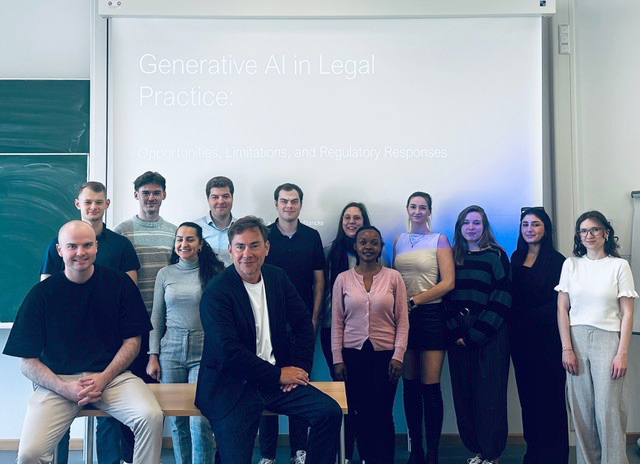
In April 2026, the Brunswick European Law School hosted an intensive block seminar on LegalTech as part of the Master's programme in Finance, Tax and Company Law (LL.M.). Under the supervision of Prof. Dr. Fabian Stancke, fifteen master's students presented outstanding research papers and delivered impressive presentations on some of the most pressing issues at the intersection of law, technology, and business.
The seminar covered a wide spectrum of topics shaping the future of the legal profession and the broader regulatory landscape. Participants explored the opportunities and limitations of generative AI in legal practice, including the hallucination problem and the requirements for responsible human oversight. The EU AI Act, set to become fully applicable in August 2026, was examined in depth alongside its interplay with the GDPR and NIS2 — with particular attention to LegalTech deployments and data protection compliance. Further presentations addressed smart contracts and blockchain technology in commercial law, legal document automation, contract lifecycle management, and AI-assisted e-discovery and document review.
Beyond technology-driven tools, the seminar engaged with broader structural questions: the consolidation of the LegalTech market, RegTech and automated compliance monitoring, access to justice through digital platforms, and the digitalisation of court systems across Europe. Cutting-edge topics such as agentic AI and autonomous legal systems, intellectual property issues around AI-generated content, and the transformation of corporate legal departments through Legal Operations were equally part of the programme. The seminar concluded with a forward-looking discussion on the future of the legal profession itself — the emerging hybrid roles, shifting competencies, and what it means to be a lawyer in 2030.
The quality of the papers and presentations demonstrated both the intellectual engagement of the participants and the relevance of LegalTech as a core competency for the next generation of legal professionals. We look forward to continuing this conversation in future semesters.