

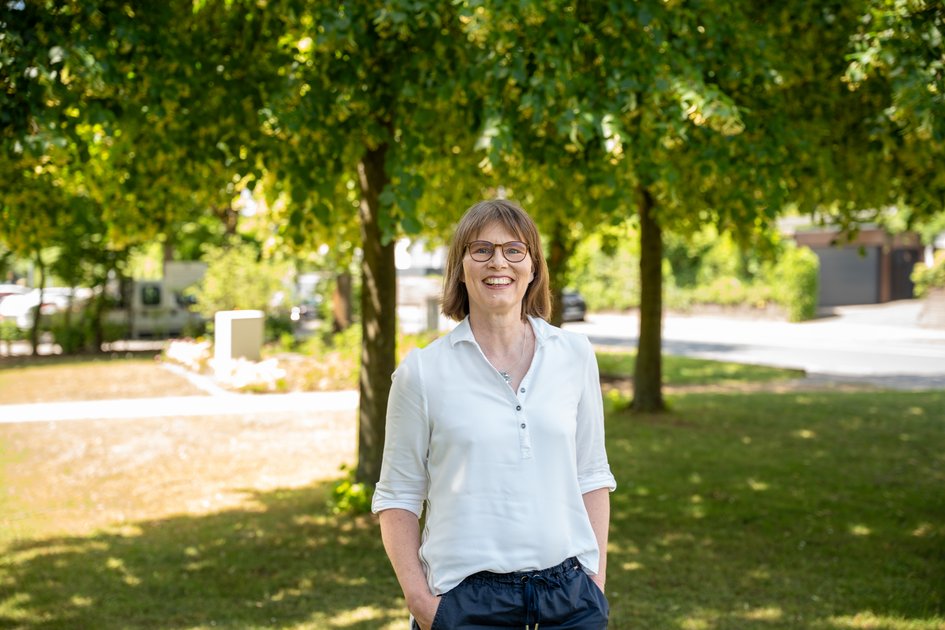
She is the sole representative of a university of applied sciences (HAW) on the Board of Trustees of the German National Academic Foundation: Prof. Dr.-Ing. Dagmar Meyer from the Faculty of Electrical Engineering and Information Technology has now been elected to the foundation’s most important governing body. There, she represents the perspectives and experiences of universities of applied sciences and contributes to discussions on fundamental issues concerning the direction and further development of the Studienstiftung.
In this interview, Prof. Meyer talks about what this election means to her, the responsibilities associated with her new role, the issues that are particularly close to her heart when it comes to supporting students, and the significance of her election for Ostfalia and its students.
Britta Radkowsky, Ostfalia editorial team: Congratulations on your election to the Board of Trustees of the German National Academic Foundation. What pleased you most when you heard the news?
Prof. Dr.-Ing. Dagmar Meyer: Thank youvery much for your congratulations. I have had close ties with the Studienstiftung since my time as a scholarship holder during my studies. After completing my PhD, I was regularly involved in selection processes; in 2007, I was then appointed as a liaison lecturer for Ostfalia – one of the first HAW professors to hold this role. I have held this post, with a break from 2014 to 2016 due to family commitments, right up to the present day. Over the last five years, I have been a member of the Studienstiftung’s Audit Committee. I have also served as an academic tutor on the non-financial support programme. It is a particular honour for me to have now been elected to the Studienstiftung’s highest governing body. As the Studienstiftung – and in particular its extensive non-financial support – is very close to my heart due to my own experiences, I am delighted to be able to play a part in shaping its direction.
What are the Board of Trustees’ responsibilities, and what duties does your new role entail?
Prof. Dr.-Ing. Dagmar Meyer: The Board of Trustees of the Studienstiftung elects the Executive Board and appoints its Chair, Deputy Chair and Treasurer. It is responsible for granting annual discharge to the Executive Board. The Board of Trustees decides on new programmes for the Studienstiftung and advises the Executive Board on all fundamental matters of substance.
Members of the Board of Trustees include a representative of the Federal Ministry of Research, Technology and Space (with three votes) and four representatives of the state governments. In addition, the major German scientific institutions each appoint one representative, namely the German Research Foundation (DFG), the Max Planck Society, the Alexander von Humboldt Foundation, the German Academic Exchange Service (DAAD), the German Rectors’ Conference and the Stifterverband für die Deutsche Wissenschaft.
Up to ten additional members are co-opted from the fields of science, the arts, education, politics, public administration or business, who are not to be representatives of organisations – including, where possible, a member of the selection committee, a liaison lecturer and a former scholarship holder of the Studienstiftung.
As the sole representative of a university of applied sciences on this committee, what perspectives and experiences would you like to contribute?
Prof. Dr.-Ing. Dagmar Meyer: Although the Studienstiftung has steadily expanded its support for students at universities of applied sciences in recent years, ever since the scheme was extended to include them in 2000, some of the framework conditions are still geared towards traditional universities. For example, many dates for the summer academies on offer fall outside the lecture-free periods at universities of applied sciences, to name just one example. Furthermore, many students at universities of applied sciences are reluctant to go through the selection process and choose not to apply even after being nominated. Furthermore, the framework conditions – particularly in technical degree programmes at universities of applied sciences, which involve numerous time-consuming laboratory sessions – sometimes limit opportunities for social engagement. I would like to work within the committee to ensure that the needs of students at universities of applied sciences are not overlooked.
Which issues relating to student support are particularly close to your heart?
Prof. Dr.-Ing. Dagmar Meyer: The broad area of non-financial support isparticularly important to me. Financial support is subject to legal requirements over which the Studienstiftung has no influence. Non-financial support in the form of summer schools, language courses, seminars and so on offers students a very special experience in many respects. They meet a wide variety of people from a diverse range of disciplines whom they would otherwise never encounter. This gives rise to stimulating discussions and a wealth of perspectives, including on their own field of study. These experiences are extremely valuable, not least in terms of tackling current and future societal challenges. In my view, maintaining and expanding this programme is of the utmost importance.
In your view, what significance does your appointment hold for Ostfalia?
Prof. Dr.-Ing. Dagmar Meyer: For Ostfalia, my future involvement on the Board of Trustees means, first and foremost, greater visibility. I am sure that at the first meeting in July, which I will be attending, many members will ask me what Ostfalia is and where it is located.