

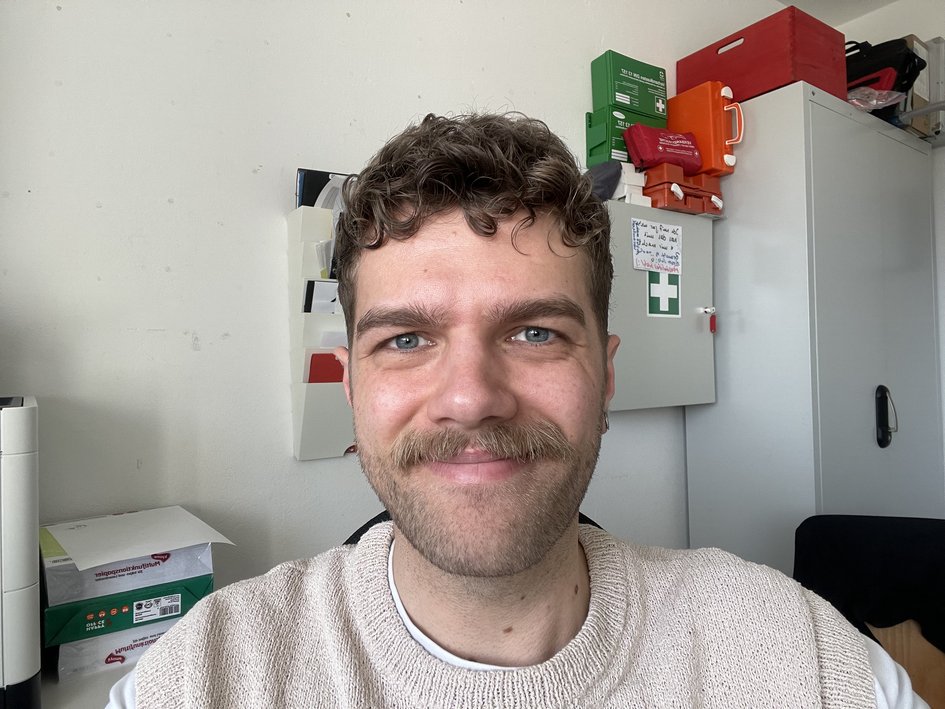
From electrician on a building site to budding social worker: André Gellert (28) is studying social work at Ostfalia University of Applied Sciences and is about to graduate. His path led him from secondary school, vocational training and an immersion course to his degree. In this interview, he talks about change, confidence and why he now realises that detours are part of the process.
Mandy Fleer, Ostfalia editorial team: André, how did you get to university?
André: I was at secondary school and had the feeling at the time that I was being steered quite clearly in the direction of an apprenticeship. So I did an apprenticeship as an electrician. I wasn't really convinced on the first day, but I didn't have any real alternatives in mind. I worked as an electrician for four years. Taking on responsibility gave me self-confidence, but the job didn't fulfil me.
How did you decide to study social work?
André : The tone on the construction site was often harsh - it just didn't suit me. And I realised that I enjoy explaining things to others and supporting them. I realised relatively quickly: if I was going to study, then social work.
What happened next?
André : Via an enrolment course. My mum studied social work herself via the second-chance route, so I knew about this option. The course lasted six months. I had a 55-hour week during that time - work during the day, school in the evening. It was really exhausting, but it was worth it. After that, I had to pass a written and oral aptitude test at Ostfalia.
How did you feel when you started your studies?
André: With respect. Above all with respect for making connections. Social work thrives on exchange, so I didn't want to be left out. The freshers' events and the back-to-campus party helped a lot. And I was able to fit in well in larger courses with around 120 students.
What did you particularly like about studying?
André : Definitely the dialogue at eye level. We discussed, reflected and scrutinised a lot. The contact with the lecturers was also very approachable. You were taken seriously and felt valued.
How practical was the programme?
André: Very! Before I started my degree programme, I did a pre-study internship in refugee aid and later a six-week internship in a residential youth group. Instead of a specialisation internship, I took part in a one-week expedition to England and gained insights into social work and social care on site. Such perspectives broaden your view enormously.
What comes after graduation?
André: After the colloquium, I will start a year of professional training in outpatient family support. There I support families with complex problems and refer them to suitable support services. I have respect for it, but above all I'm confident that I'll do well.
What advice would you like to give prospective students?
André: Change is scary, but it's part of it. Studying changes you. When you reflect on it, you realise how much you grow. And: a perfect plan rarely works. But somehow it always goes on. You find your way, even if it's not straightforward.