

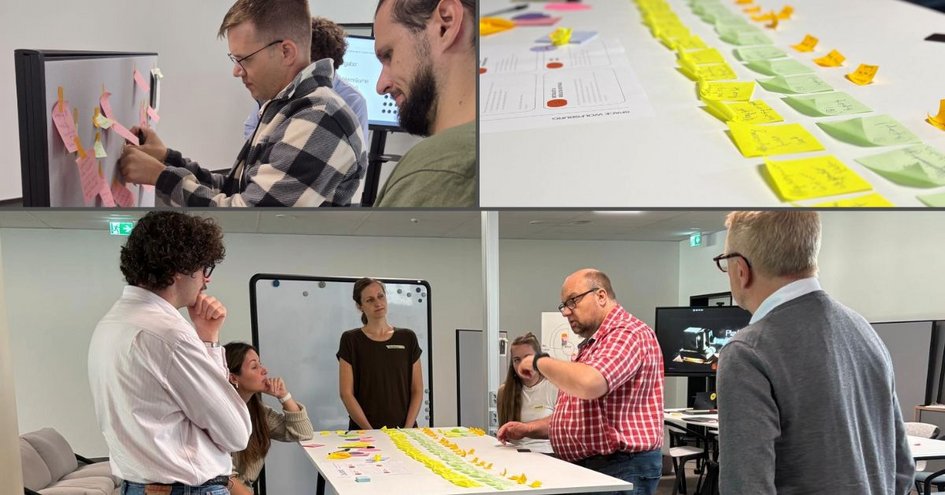
What might healthcare look like in 2030? What challenges do we need to tackle today? And what role can artificial intelligence and data-driven technologies play in this?
The Faculty of Health Sciences at Ostfalia University of Applied Sciences is addressing these questions in collaboration with the SPAICE project team at Wolfsburg Wirtschaft und Marketing GmbH (WMG) and the City of Wolfsburg. As part of two vision workshops, lecturers and students from the faculty were able to contribute their specialist expertise and examine specific challenges facing the healthcare sector.
Focus on home care and case management
The first vision workshop, ‘Home Care and Case Management’, centred on the question of what better-coordinated and needs-based care in the home environment might look like in 2030. Particular attention was paid to the perspectives of care professionals and family carers.
From the perspective of community care, route planning was one of the issues examined. In community psychiatric care in particular, individual needs, time constraints, qualifications, travel routes and last-minute changes must all be balanced against one another. From the perspective of family carers, however, the focus was on navigating the care system: where can those affected find information and suitable points of contact? What support services are available, and how can necessary services be organised and funded? The psychological strain on family carers was also discussed.
Overall, it became clear just how many different stakeholders are involved in home care. For those affected, it is often difficult to identify which services are available in their region and who they can turn to with a specific enquiry. A digital overview of regional services, points of contact and areas of responsibility could provide guidance here and improve networking. Challenges also arise during the transition from hospital to further care, for example when relevant information does not reach the subsequent care providers in full or in good time.
On this basis, the participants developed initial visions for home care in 2030 and discussed possible starting points for digital and data-driven solutions. Alongside lecturers, students from the ‘Vocational Education and Management in Nursing’ degree programme also took part. They were able to experience first-hand how specific challenges in care give rise to problem areas and, in turn, ideas for innovative solutions.
Focus on the acute care chain
The second vision workshop, ‘The acute care chain from the scene of the incident to clinical care’, focused on care from the emergency call through to further clinical treatment. Three colleagues from the Faculty of Health Sciences contributed their perspectives.
A key topic was the coordination of the various stages along the care chain: from the emergency call, via the control centre and the emergency services, to the receiving care facility and the specialist department providing follow-up care. It is precisely at these interfaces that information is lost. Discussions therefore centred, amongst other things, on ways to ensure secure and efficient digital documentation of operations, as well as improved sharing of relevant information.
The feedback of information was also identified as an important opportunity. Emergency medical service interventions are often guided by key symptoms and a suspected diagnosis derived from them. However, emergency services personnel often do not find out whether this assessment is confirmed in the course of further treatment or which measures proved to be effective. In addition, digital support options for emergency calls, traffic management during emergency operations and a more needs-based management of emergency calls were discussed. Greater integration with existing care structures could help to refer patients more effectively to the appropriate care in each case.
Particularly interesting was the realisation that many of the challenges discussed are not entirely new and that solutions already exist for numerous problems. The challenge lies rather in linking existing solutions together effectively, rolling them out across the board and integrating them permanently into care processes.
Bringing university knowledge into practice
For the Faculty of Health Sciences, the collaboration with SPAICE offers the opportunity to contribute academic expertise and practical experience from healthcare settings to regional innovation processes. At the same time, new contacts are being forged with companies, start-ups, start-up teams and other stakeholders in the region.
A particular added value lies in the combination of teaching, innovation and start-up support. Students should not only learn to apply and critically evaluate existing digital technologies in the healthcare sector; they should also be encouraged to develop their own ideas and help shape innovative solutions. The collaboration with SPAICE offers a practical approach to this: students can gain an understanding of real-world challenges and experience how a problem area can give rise to an idea, a pilot project and, in the long term, a viable business model.
“For us as a faculty, it is particularly exciting to contribute our expertise from academia and healthcare practice to concrete innovation processes, whilst at the same time opening up new perspectives for our students,” says Bianca Steiner, Professor of Digitalisation in Healthcare.
The two workshops were a first step. The collaboration between the Faculty of Health Sciences and the SPAICE project team is set to be further developed through additional workshops. The aim is to jointly address specific challenges in the healthcare sector, develop innovative solutions and, in the long term, support their implementation.
Further information on SPAICE: https://spaice-wolfsburg.de/ (external link, opens in a new window)