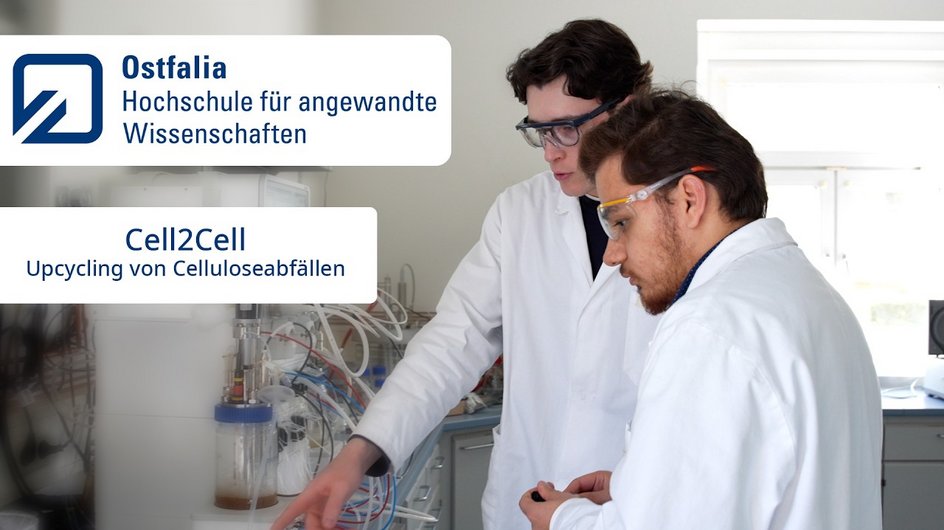

Conversations in the toilet are rarely about research. And the bioeconomy isn’t exactly a topic for small talk either. Yet a team of researchers at Ostfalia University of Applied Sciences has managed to bring ‘hands-on research’ to life in the truest sense of the word. In collaboration with public institutions, they’re informing visitors and staff about the recycling of paper towels: the research team extracts sugar from the paper waste as a valuable raw material for new products. And everyone can play their part.
Hands-on research in the washroom
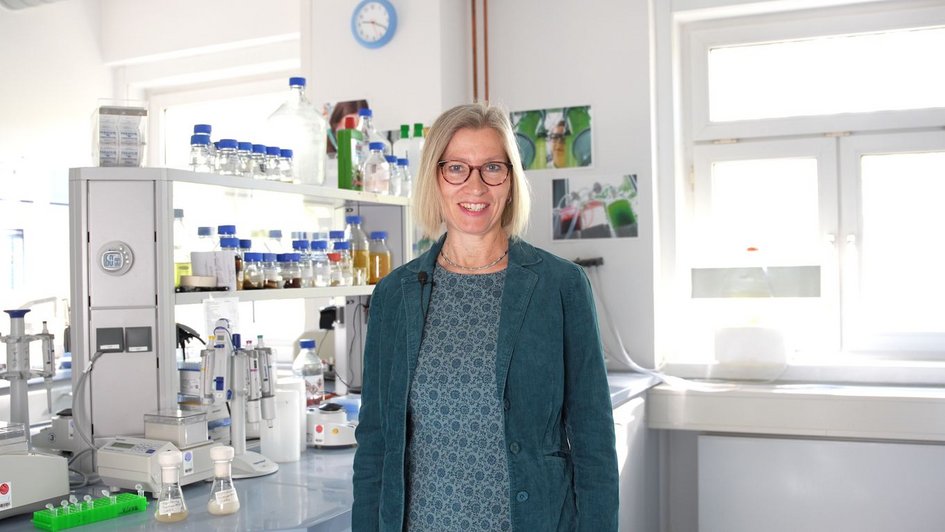
Bioeconomy – what is it? And what’s in it for me? The researchers at the Institute of Biotechnology and Environmental Research have often heard reactions like these. As part of the “Cell2Cell” project, they are developing processes to recycle used paper towels. Every year, around 70,000 tonnes of paper towels are thrown away in Germany and incinerated with general waste. Recycling hasn’t been viable so far. Yet paper towels consist mainly of cellulose, a polysaccharide that specific enzymes can break down into the simple sugar glucose. “Who throws sugar in the bin?”, asks project leader Prof. Dr Elke Wilharm, championing the bioeconomy. From washroom waste, she produces a sugar solution which microorganisms such as yeasts and bacteria convert into a wide range of new valuable materials. These include substitutes for fossil-based raw materials and plastics.
Recovering sugar from paper towel waste
To scale up the technical process from the laboratory to everyday use, the team led by Elke Wilharm, Diana Lorenczyk and Malin Schleicher needed larger quantities of used paper. “We launched an information campaign and managed to get eleven interested organisations in Wolfenbüttel to work with us,” reports Elke Wilharm. “The fact that paper contains so much sugar and that this can be recovered sparked their curiosity and a desire to get actively involved.” The research team visited the participating local authorities, nursery schools, sports clubs, an outdoor swimming pool, a museum, a church parish and the THW in person, presented the project and discussed the test collection.
Raising awareness encourages participation
The managers of these organisations instructed their staff and cleaning personnel to collect paper towels separately from other operational waste. In doing so, the researchers encountered a problem: unwanted residual waste mixed in with the used paper towels, which they had to laboriously sort out by hand. Venues that asked their guests in the washrooms, via additional information signs, to avoid disposing of waste other than paper towels, and provided details of the campaign via a QR code, reduced the amount of contaminating material by up to 75 per cent. “It was very encouraging,” says Elke Wilharm, describing her experience, “to see that people can be motivated to get involved through clear information.” In this way, the principle of the bioeconomy – a bio-based circular economy – as well as an appreciation for everyday goods can be communicated to society.
The original article appeared in “ti” 3/2025: Transfer into practice. Knowledge to the power of N..