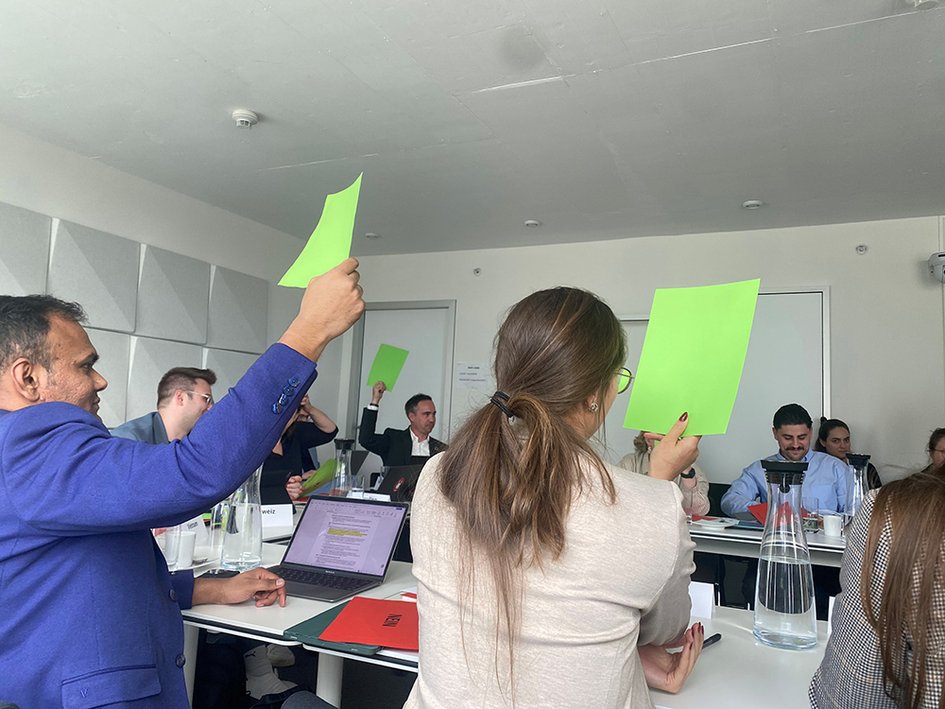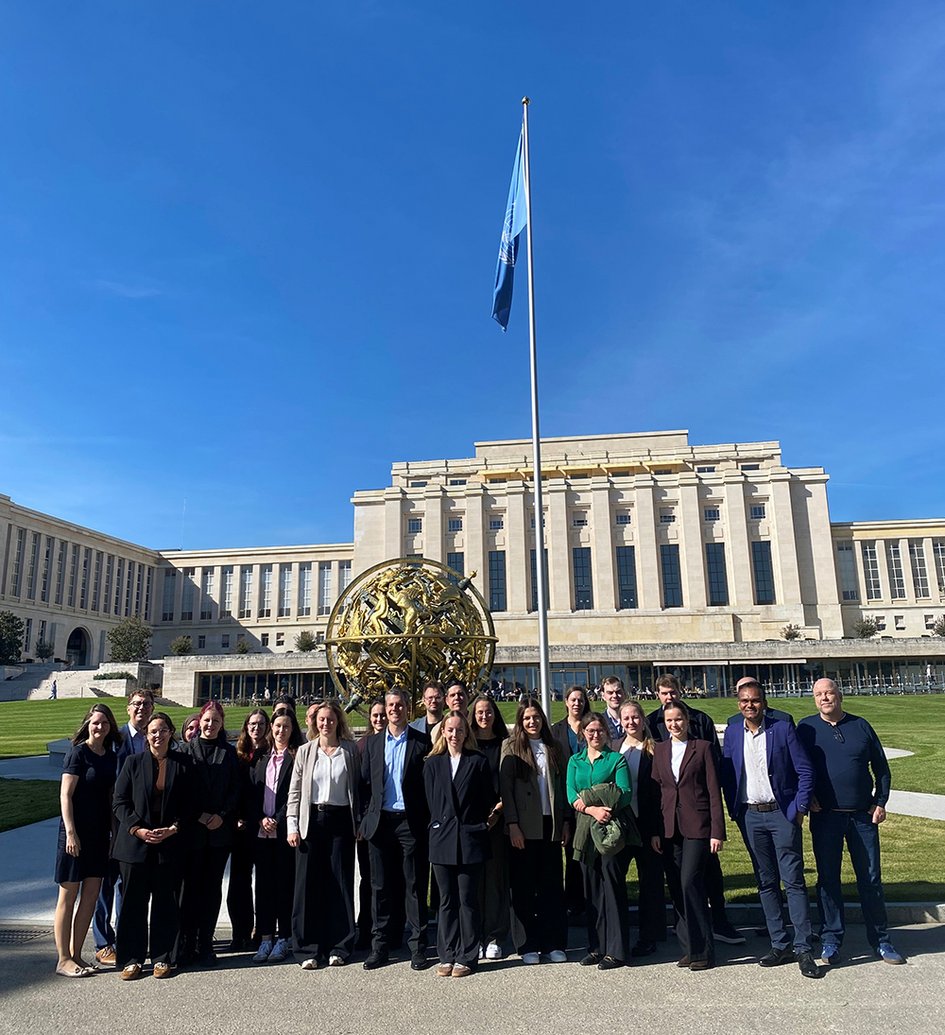
From 14 to 17 October 2026, 15 students from the Brunswick European Law School (BELS) at Ostfalia University of Applied Sciences travelled to Geneva together with students from the University of Applied Sciences of Graubünden. The focus was on the SDGnext simulation. In this simulation, the participants negotiated which sustainability goals the United Nations should adopt for the period after 2030. Prof. Dr. Olaf Schlotmann and Anna-Theresia Becker MA accompanied the German group, whilst Prof. Dr. Christian Hauser accompanied the Swiss group.
A tried-and-tested format
Simulations modelled on Model United Nations have a long tradition at BELS as a compulsory elective subject. Anna-Theresia Becker has authored the textbook “Model United Nations – A Practical Guide” on this topic. The SDGnext simulation, developed by Prof. Dr. Hauser, is a compact version of this format, tailored to last just a few days. Students learn how multilateral negotiations work and experience international decision-making processes from various perspectives. The collaboration arose through the UN PRME (Principles for Responsible Management Education) network.
Negotiating from different perspectives
In the simulation, the students represented states and interest groups, ranging from major powers such as the US and Russia to countries with less negotiating clout, such as Colombia. They debated controversial positions, sought compromises and drew up proposals for future global sustainability goals. In the end, they jointly adopted a resolution. In doing so, they experienced first-hand just how complex international negotiations are and how much depends on dialogue and a willingness to compromise.
Insights into real-world practice
The programme also included a visit to the Palais des Nations, the former Palace of the League of Nations and now the headquarters of the United Nations in Geneva, as well as lectures by experts from the fields of diplomacy, academia and professional practice.
Andrea Ostheimer from the Konrad Adenauer Foundation’s Geneva Multilateral Dialogue Office spoke about the importance of multilateralism in today’s world. Marco Crugnola from the Prosperity and Sustainability Division of the Federal Department of Foreign Affairs (FDFA) shared practical insights from international negotiations with various stakeholder groups. Amri Sherzamonov from the Office of the United Nations High Commissioner for Human Rights (OHCHR) provided insights into the UN’s human rights work.
Prof. Dr Olaf Schlotmann described climate protection as a global prisoner’s dilemma, which the EU’s carbon border adjustment mechanism can only mitigate. Traditional ESG investing does little to reduce emissions; sustainability-linked bonds are more effective because they tie financing costs to sustainability targets. Legal expert Dr Annette M. Schüller compared soft law, hard law and the Sustainable Development Goals (SDGs), highlighting their significance for companies and their supply chains.
Acknowledgements
Our heartfelt thanks go above all to Prof. Dr Christian Hauser and his team at the University of Applied Sciences of Graubünden for their excellent organisational, logistical and content-related preparation, and for jointly running the simulation. We would also like to thank Andrea Ostheimer and her team at the Konrad Adenauer Foundation for providing the venue and on-site support, as well as all the speakers for their practical contributions.