
The consequences of climate change are presenting cities and local authorities with growing challenges. The damage caused by drought is no longer confined to forests; it is now clearly visible in the urban landscape as well. The situation is exacerbated by extreme weather fluctuations: the alternating occurrence of prolonged periods of drought and sudden heavy rainfall no longer merely puts a strain on vegetation, but puts the entire urban system to the test. Whilst plants suffer from acute water shortages, subsequent heavy rainfall events mean that the parched and, in some cases, sealed soils cannot absorb the massive volumes of water quickly enough. The water is lost to the plants and also leads to the urban drainage system becoming overloaded
To help street trees and green spaces survive these extreme phases, an enormous amount of manpower and technical resources is required: large quantities of water must be transported to the sites and, once there, are often distributed using the inefficient ‘watering can principle’. This intensive watering ties up valuable staff resources – resources that are already scarce and expensive in times of a skills shortage, and which are urgently needed elsewhere.
Collaboration with Hohrenk Systemtechnik GmbH
Ostfalia is working with Hohrenk Systemtechnik GmbH on the “SmartCity Irrigation” research project to investigate how the irrigation of urban green spaces can be made smarter, more resource-efficient and more effective in future. The project idea arose from the completed sub-project ‘5G-Smart-Forestry’ and a student project, in which a group of students developed an initial demonstrator for a self-sufficient irrigation solution in the form of a bench. This is still located on the Wolfenbüttel campus between Building “C” and the Faculty of Law building.
Collecting rainwater and irrigating as required
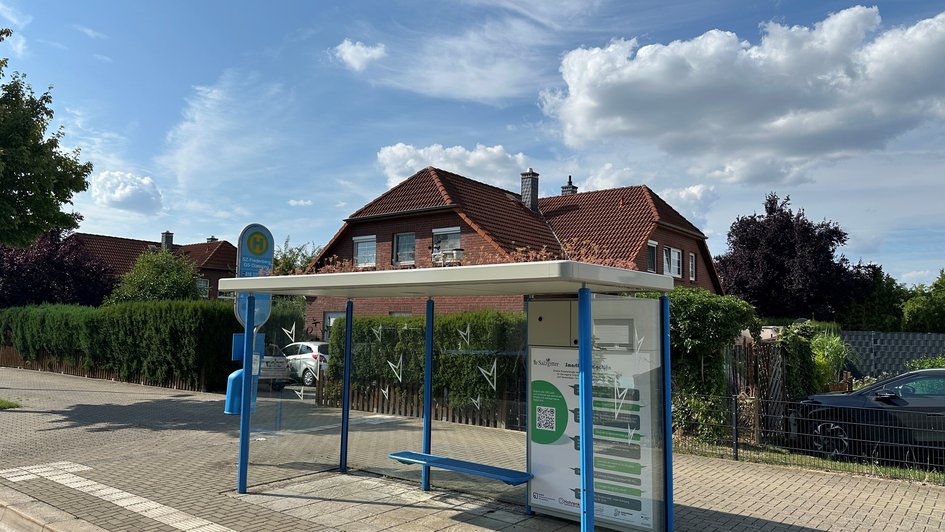
The aim of the project is to equip a total of ten bus shelters in the region with self-sufficient irrigation technology. Rainwater collected from the bus shelters is stored in integrated water tanks and subsequently used to water the shelters’ own green roofs, roadside trees or adjacent green spaces.
Hohrenk Systemtechnik GmbH is responsible for the planning, manufacture and installation of the water tanks on the existing bus shelters. Ostfalia is equipping the systems with IoT technology and sensors and is developing the smart control system. Via a digital user interface, operators can view relevant sensor and operational data – such as tank levels or weather data – at any time. Should irrigation or refilling be required, the relevant authorities can be notified accordingly. This is where the participating faculties of Computer Science (Professor Ina Schierung) and Mechanical Engineering (Professor Andreas Ligocki) work hand in hand.
An exciting side effect is that, in addition to controlled irrigation, the local authorities gain insight into local climate conditions via the installed local weather stations, enabling them to identify ‘hotspots’ within the city. Furthermore, an integrated gateway – if required – enables communication with other IoT systems. The bus shelters then effectively function as ‘hotspots’ for other tasks as well. By combining rainwater harvesting, sensor technology, automated control and digital data provision, the aim is to reduce the effort required for manual watering whilst enabling the economical and needs-based use of water resources.
First systems successfully operational in four local authorities
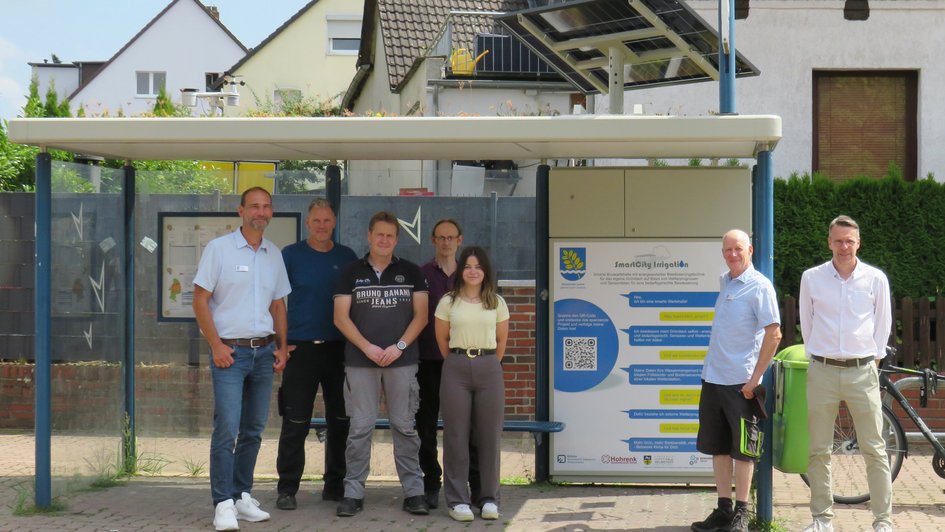
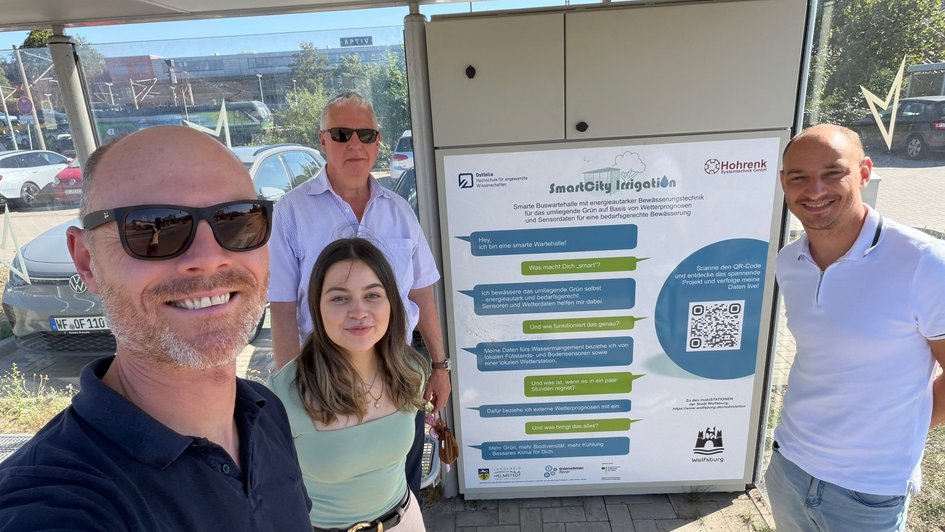
An important milestone in the project has already been reached: in the city of Salzgitter, the municipality of Lehre and the city of Wolfsburg, the first six SmartCity Irrigation systems have now been successfully installed, commissioned and handed over to the local authorities. Two further bus stops in Braunschweig have also been fitted with SmartCity Irrigation systems and successfully put into operation. This means that the system developed is now being operated in our region at various locations and for different irrigation tasks under real-world conditions.
In Salzgitter, three bus shelters have been fitted with the smart irrigation technology. Two systems on Dürerring each supply their own green roof with stored rainwater, with one of the bus shelters also featuring a weather station. At the third location in Salzgitter-Sauingen, the collected rainwater is used to water a street tree.
In the municipality of Lehre, two further systems are in operation. Opposite the police station in Lehre, the green roof of a bus shelter is irrigated and meteorological data is recorded via an additional weather station. At the site in Flechtorf, opposite the TEDOX shop, the stored rainwater is again used to water a roadside tree.
In Wolfsburg, too, the SmartCity Irrigation system has been installed and commissioned at the bus stop at Fallersleben railway station, within the area of the local mobiSTATION. The rainwater collected there is used to water a newly planted tree. This marks the first time in Wolfsburg that a bus shelter has been combined with rainwater storage, sensor technology and automated watering.
In Braunschweig, two tram stops with existing green roofs were retrofitted and equipped with the intelligent, demand-responsive irrigation system.
The sites where the system has already been implemented demonstrate the various possible applications of the system: from the automated watering of greened shelter roofs to the targeted watering of urban trees. At the same time, the systems provide important sensor and operational data whilst in operation, which can be used to further optimise irrigation strategies and the overall system.
Further local authorities to follow
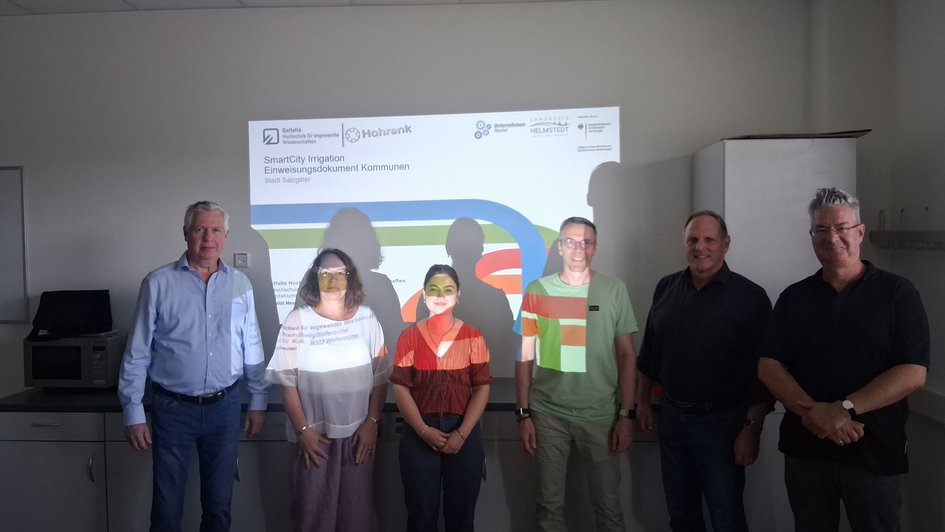
With the training sessions in Salzgitter, Lehre and Wolfsburg, the implementation of the project is not yet complete. As the project progresses, the final training sessions will take place in two further local authorities. This will see the practical trial finally extended to additional sites, the transferability of the developed solution to a wide variety of local authority contexts further investigated, and the project successfully completed on schedule.
The aim is to draw insights from the experiences of all sites for the future, wider deployment of intelligent and self-sufficient irrigation systems. In addition to technical reliability, the focus is particularly on demand-based irrigation, the efficient use of available rainwater and integration into municipal processes.
The SmartCity Irrigation project is funded by the Federal Ministry for Economic Affairs and Energy (BMWE) as part of the federal model project ‘Unternehmen Revier’ (funding reference: 20.03_UR_P_03/2024). The project is being carried out in collaboration with the Faculties of Computer Science and Mechanical Engineering, as well as Hohrenk Systemtechnik GmbH.
Contributing to sustainable and digital local authorities
The SmartCity Irrigation project combines climate adaptation with digitalisation and contributes in particular to the following objectives:
• Preservation of urban trees, as well as promotion of the microclimate and the binding of particulate matter,
• the economical and sustainable use of water resources,
• Utilising and storing rainwater directly on site,
• the digital and smart upgrading of existing bus shelters,
• needs-based irrigation based on sensor and operational data,
• Integration into existing digital infrastructure in local authorities,
• Transferability of the developed methodology to other irrigation applications,
• Public engagement and awareness-raising, for example through tree sponsorship schemes,
• Promotion of digitalisation in urban and rural areas, as well as
• Optimisation of irrigation and refilling route planning for more efficient use of staff and machinery resources.
Discussions with local authorities clearly demonstrate that the SmartCity Irrigation project is right on the pulse of our times. It bridges the gap between theory and practice and demonstrates how applied research can be profitably integrated into everyday life – a real benefit for the local authorities, Ostfalia and the company Hohrenk, and above all for what unites us all: our environment.