

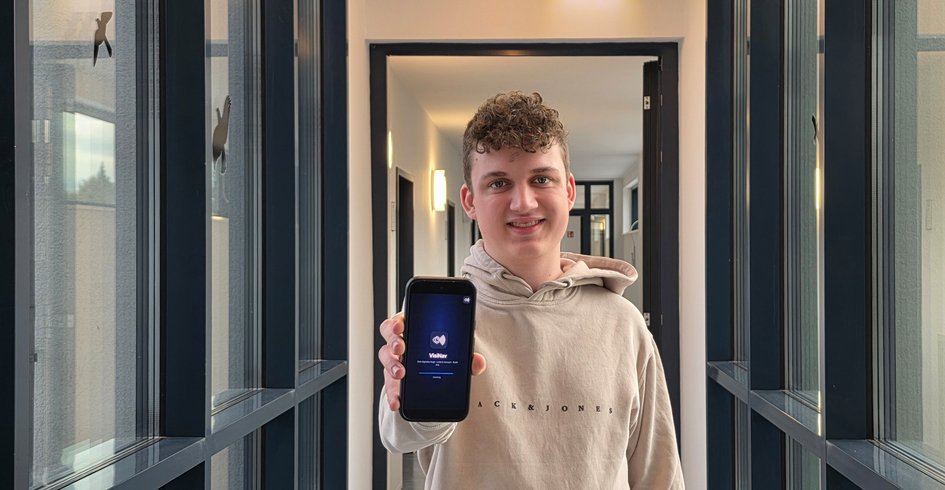
At the age of 13, Timo Henkel built his first computer together with his father. The now 19-year-old discovered a passion for programming and development at an early age. This passion took him to the final of the prestigious ‘Made in Germany’ Awards, which were presented on 23 November at the Futurium in Berlin. With the prototype of his app “VisiNav”, an application for visually impaired and blind people, the Ostfalia student won over the audience in the final public vote and was presented with the award in the Artificial Intelligence category. A jury had previously selected 15 finalists across five categories.
The nationwide ‘Made in Germany’ Awards, in collaboration with the Federal Ministry of Research, Technology and Space and the Federal Agency for Breakthrough Innovations (SPRIND), recognise outstanding projects and inventions that improve our future in an intelligent and sustainable way.
The “VisiNav” application developed by Timo Henkel uses the smartphone’s camera in combination with locally running AI models to detect obstacles in real time. Users hear spatial signals through their headphones indicating the direction of the clear path. “Additional functions can be accessed via voice control, such as a money-counting function, or I can search for an object or have my current surroundings described to me,” explains Timo Henkel, who is in his first semester studying Electrical and Information Technology at Ostfalia. What makes it special is that everything works completely offline, without a cloud connection. The AI processes all the data directly on the smartphone.
The idea was sparked by an online article he came across whilst in Year 12. The article highlighted that traditional aids, such as white canes, do not detect obstacles at head or chest height, whilst other smart solutions, such as assistance dogs, are often incredibly expensive. “I was already on the lookout for a new programming project anyway, so I got started. I always find it more exciting to develop something that has the potential to be genuinely useful in practice,” he explains. Timo Henkel never imagined that the project would attract so much attention.
Since being nominated for the ‘Made in Germany’ Awards, the student has received a great deal of feedback, particularly from people who themselves live with a visual impairment. He says this exchange has been incredibly valuable and represents the next step for him in further developing his prototype and testing it together with the target group. “The prototype works. But the app isn’t quite finished yet. And now I’ve reached a point where it’s becoming difficult for me to manage on my own,” says Timo Henkel, hoping that the exposure and network he has gained through the award nomination and the prize itself will help him take the next steps.
Note: The recording of the ‘Made in Germany’ Awards is available on YouTube (external link, opens in a new window).
The Artificial Intelligence category and Timo Henkel’s project are covered from 1:38:30.