

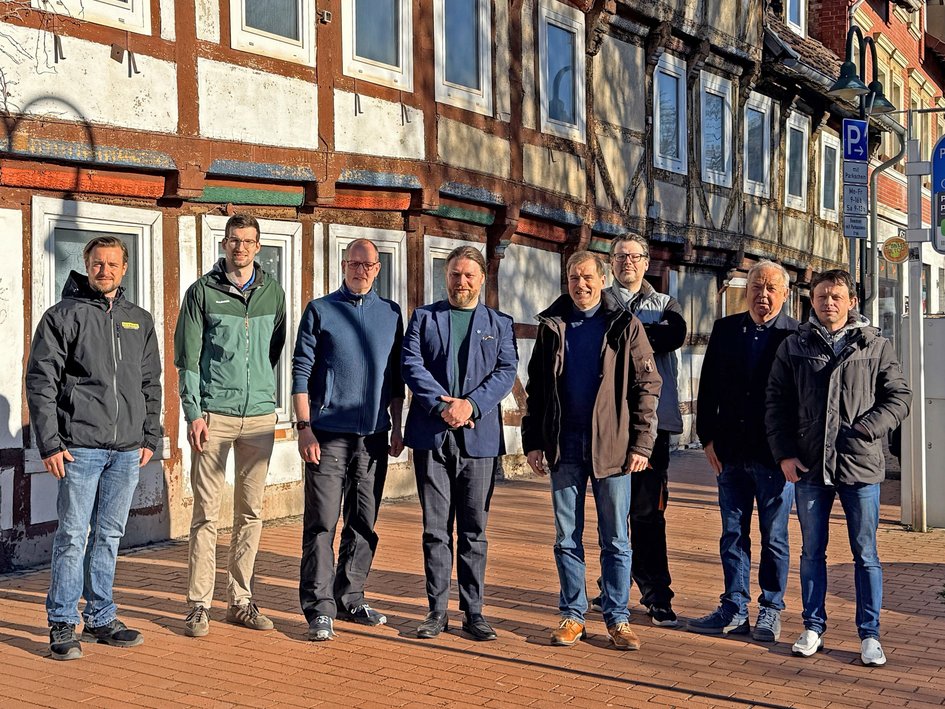
The research and development project has successfully moved into its next phase with an initial joint site visit. DISAFA stands for ‘Digital process chains for the energy-efficient refurbishment of half-timbered buildings’. The aim of the project is to fundamentally improve the refurbishment of historic half-timbered buildings and make the process more efficient through the use of digital technologies.
The half-timbered house ‘Die Krone’ in Helmstedt is serving as the real-world laboratory. The building has stood empty for some time. It is centrally located in the town and is familiar to many residents of Helmstedt. It is precisely this situation that makes it a suitable site for the development and testing of new methods for dealing with historic building fabric.
It is important to note the context: the DISAFA project is not part of a comprehensive building renovation, but rather precedes it. The aim is first to research and develop the digital foundations, procedures and tools, and to test them on this specific property. The findings are then to be incorporated into a subsequent renovation that complies with heritage conservation standards and can be applied to other projects.
“The renovation of half-timbered buildings today is often still heavily reliant on traditional craftsmanship and involves a great deal of effort. With DISAFA, we aim to use digital tools in such a way as to significantly improve quality, efficiency and resource conservation,” say the project participants on site.
At the heart of the project is the development of digital process chains, ranging from the 3D scanning of existing half-timbered structures to the automated production of precisely fitted components. In particular, robot-assisted processes are to be used to precisely account for the high complexity of historic buildings – such as deformations, settlement and individual component geometries.
The project is part of the federal pilot scheme ‘Unternehmen Revier’. Alongside technological development, DISAFA also aims to establish new value chains. Furthermore, knowledge of innovative renovation methods is to be systematically transferred into training and practice.
DISAFA is thus creating an innovative approach that combines heritage conservation, digitalisation and sustainable construction – and opens up new perspectives for dealing with the region’s extensive stock of half-timbered buildings.
The project partners have now come together for the first time at a specific property to prepare for the implementation of the developed approaches in the existing building stock. Those involved were:
- Ostfalia University of Applied Sciences
- Florahof Verwaltungs- und Vermittlungs-Gesellschaft
- Studio Leonhard Pröttel Architecture
- WINOBO 3D Scan & Build
- Schaab Timber Engineering