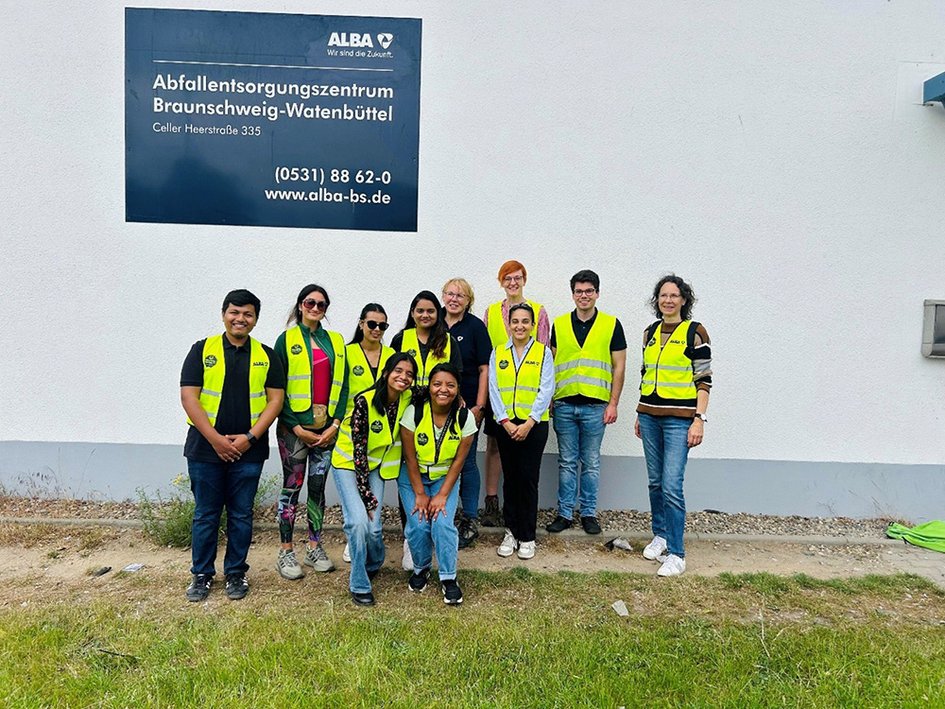
On 4 June 2025, students participating in the DAAD-SDG Partnerships Project “Implementation of the Sustainable Development Goals – India, Nepal and Germany” undertook an educational site visit to the ALBA facility in Braunschweig, accompanied by Shahryar Tavana, a former BELS student and founder of the innovative Trash Tracker project.
The ALBA Group, one of Europe’s leading environmental services and recycling companies, operates at the forefront of circular economy practices. With a strong emphasis on waste separation, material recovery, and technological efficiency, ALBA processes a wide range of recyclable waste-transforming discarded materials into raw resources that re-enter the value chain. Its Braunschweig facility stands as a model for industrial-scale urban recycling.
Shahryar Tavana, known for his work in sustainability innovation and grassroots environmental awareness, accompanied the student group and facilitated interactive discussions throughout the visit. His insights added a dynamic, real-world dimension to the students' academic understanding of sustainability.
During the guided tour of the ALBA facility, students observed the meticulous processes involved in sorting, classifying, and processing recyclable waste. From conveyor belt systems using AI-driven sorting technologies to material recovery stations that extract metals, plastics, and paper with minimal contamination, the visit provided a firsthand view of Germany’s advanced recycling infrastructure.
Students found it particularly striking that residents in Braunschweig regularly bring their electronic and hazardous waste directly to ALBA, ensuring that these items are handled and recycled in a manner that is both safe and environmentally responsible. They also learned that certain types of non-recyclable waste are compressed and transported to energy recovery facilities, where they are incinerated under controlled conditions to generate electricity, further demonstrating how waste streams can be converted into valuable resources.
What stood out to students was how waste, typically viewed as the endpoint of consumption, is reimagined as a resource within a functioning circular economy. They learned that even the smallest behavioural changes, when supported by efficient infrastructure and civic participation, can contribute to large-scale environmental outcomes.
This excursion reaffirmed the essential connection between effective waste management and long-term sustainability. By witnessing how discarded materials are reintegrated into the economy through innovation, infrastructure, and precision, students developed a deeper understanding of sustainability as a shared scientific, social, and civic responsibility.