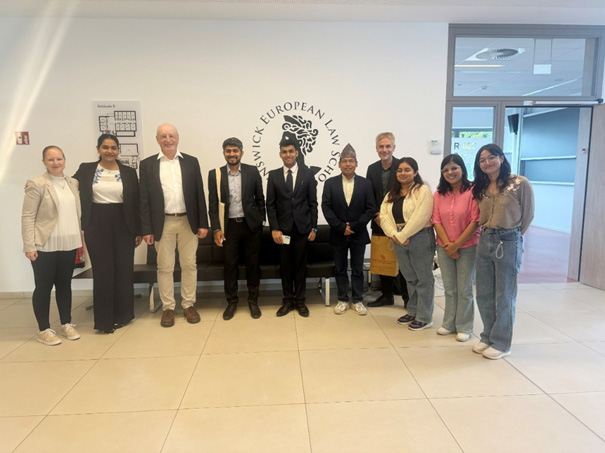
The Brunswick European Law School (BELS), Faculty of Law, at Ostfalia University of Applied Sciences, Germany, hosted the Kick-Off Week of the joint SDG–DAAD project, “Implementations of the SDGs – A Comparative Approach in India, Nepal and Germany,”from 20 to 30 September 2024. The Kick-Off Week marked the start of activities for the four-year collaborative project, running from 2024 to 2027 and supported by the German Academic Exchange Service (DAAD). The initiative brings together faculty members and students from Ostfalia University of Applied Sciences, Germany; Symbiosis Law School, Pune, India; and Kathmandu University School of Law, Nepal. The project aims to strengthen international academic cooperation and develop comparative approaches to implementing the United Nations Sustainable Development Goals (SDGs) across diverse legal, social, cultural and economic contexts, with a particular emphasis on translating academic knowledge into practical, community-oriented sustainability initiatives.
The kick-off event began with an inaugural presentation by Prof. Dr. Achim Rogmann, Professor of Public Economic Law, focusing on European Union law, foreign trade law and customs law, and Dean International at BELS. His address highlighted the importance of internationalisation, cross-border academic partnerships and interdisciplinary engagement in advancing sustainable development. The subsequent sessions provided visiting faculty and students with insights into Ostfalia University’s academic structure, student support services, career development opportunities and international collaboration initiatives. Prof. Dr. Rosemarie Karger, President of Ostfalia University, welcomed the visiting delegates and emphasised the importance of an inclusive academic community and global engagement. Elke Wesche-Möller also introduced the university’s academic framework, teaching methodologies and expectations for students.
A key academic session examined the relationship between European Union foreign trade law and the SDGs. Prof. Dr. Rogmann discussed how trade regulations can support fair trade, environmental protection, economic equality and sustainable economic practices. The programme also featured a Sustainability Forum led by Prof. Dr. Olaf Schlotmann, where participants explored innovative approaches to addressing climate change through sustainable spending and debt financing. Prof. Dr. Udo Becker provided English translations, ensuring that international participants could engage meaningfully in the discussions.
The visit to the Marienborn Memorial at Checkpoint Alpha added a historical dimension to the programme, introducing participants to the former border crossing between East and West Germany during the Cold War. Further discussions with university representatives covered student and faculty exchanges, academic credit recognition, course catalogues and the finalisation of institutional agreements. The delegates also explored opportunities for joint research and a collaborative publication featuring regional case studies on sustainable development, bringing together perspectives from India, Nepal and Germany.
A particularly significant component of the programme was the meeting with Mr Shahryar Tavana, Co-Founder of the Trash Tracker Initiative. The initiative’s community engagement model demonstrated how environmental awareness can be translated into practical action through clean-up drives, waste-segregation workshops, recycling documentation, digital media campaigns and public outreach. These discussions laid the groundwork for a proposed Trash Tracker Summer School in 2025, designed to encourage experiential learning and cross-border collaboration among students and faculty from the partner institutions.
The conference also identified concrete areas for future cooperation. Discussions included campus-based tree planting, with plans to allocate responsibilities between Symbiosis Law School and Kathmandu University according to institutional capacity; the adoption of an SDG simulation model to enhance student engagement; and the development of collaborative research outputs. Preparations for student and faculty exchanges during the 2025 summer semester, alongside German-language training for participating students from India, were also discussed.
The Kick-Off Week marked an important step towards building a sustained partnership among the three institutions. By combining academic deliberations, institutional engagement, historical learning and community-oriented sustainability initiatives, the project sought to bridge the gap between knowledge and practice. Its broader vision is to empower students and faculty to contribute actively to sustainable development through comparative research, innovative teaching and meaningful engagement with society. The collaboration reflects a shared commitment to advancing the SDGs through higher education and to strengthening the transfer of knowledge from university campuses to the wider community.