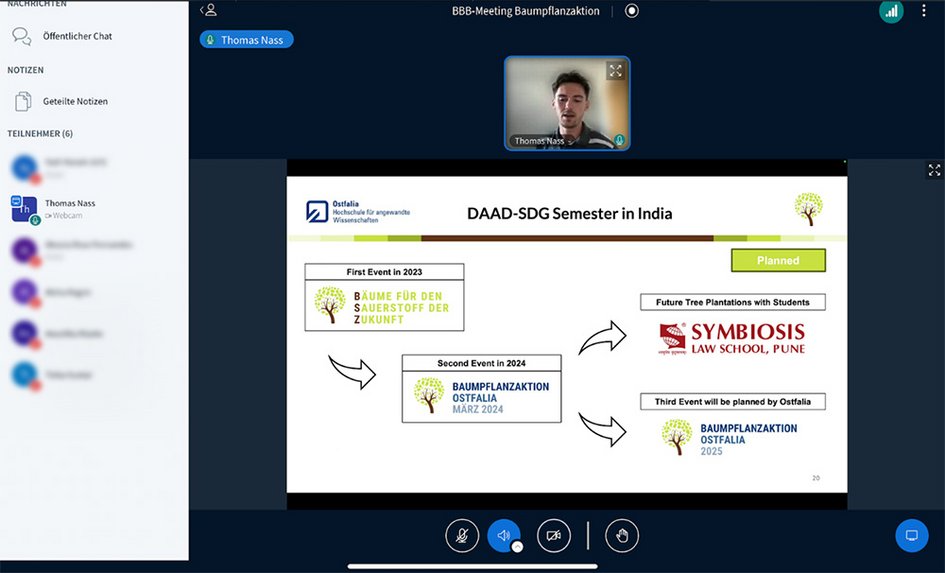
On June 12, 2025, as part of the DAAD-SDG Partnerships Project "Implementation of the Sustainable Development Goals – India, Nepal and Germany”, the participating students were invited to a deeply inspiring virtual session led by Thomas Nass, a senior student at Brunswick European Law School (BELS), Ostfalia University of Applied Sciences. Thomas Nass, who spent the previous semester at Symbiosis Law School, Pune, India, under the DAAD-SDG exchange programme, shared his personal journey of spearheading one of the region’s most impactful student-led environmental initiatives—now considered a hallmark of civic engagement and sustainability at Ostfalia.
He explained that what began as a classroom discussion on the European Green Deal evolved into a long-term, community-based initiative that has seen thousands of trees planted in the Elm region. Through careful planning, collaboration with local forestry authorities, and student volunteerism, the initiative has now completed three successful plantation drives. Each event not only enhanced the region’s ecological balance but also underscored the power of grassroots commitment to environmental stewardship.
What made the session particularly meaningful for attendees was how it bridged theory and practice. Students from India and Nepal appreciated the tangible demonstration of how environmental activism can be thoughtfully integrated into everyday academic life. They reflected on the importance of long-term planning, the role of community in driving sustainable action, and how setbacks can serve as stepping stones for greater impact. Many expressed renewed motivation to initiate similar efforts in their own regions, having witnessed how a single idea—when nurtured with purpose—can grow into a legacy.
Thomas Nass also reflected on his enriching semester at Symbiosis Law School, Pune, under the DAAD-SDG exchange programme, where he actively participated in environmental awareness drives and plantation activities alongside students from India and Nepal. Immersed in a vibrant intercultural setting, he gained first-hand insights into community-based sustainability efforts in urban Indian contexts-ranging from biodiversity gardening to the legal dimensions of ecological protection. This experience, he noted, deepened his understanding of environmental challenges in the Global South and inspired him to adapt several ideas - including inclusive volunteer mobilisation and localised awareness campaigns - into his own project back in Germany. He described his time in India as “insightful, collaborative, and transformative,” laying the foundation for a global perspective on sustainability.
Participants left the session inspired, reflecting not only on the technical and environmental aspects of the project but also on its deeper message: that long-term sustainability begins with small, persistent acts of care for our shared world.