

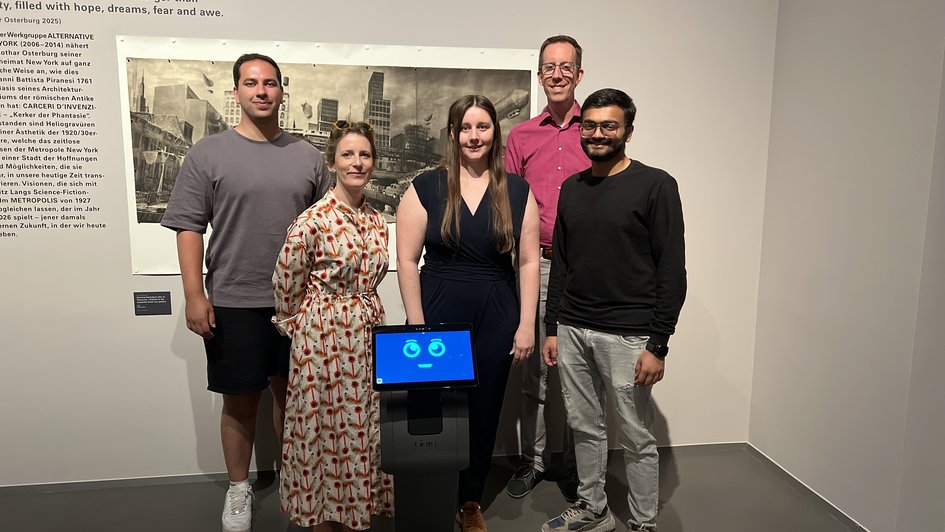
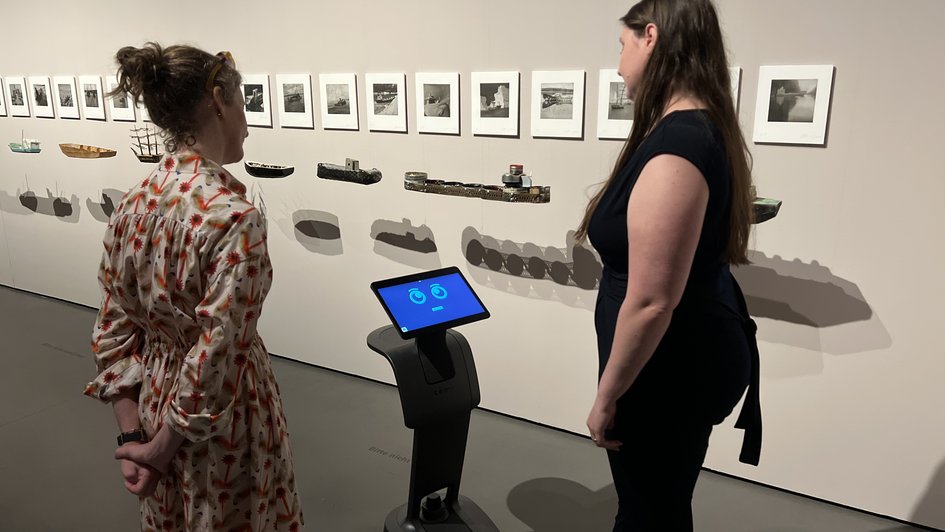
How should a robot speak in order for people to accept it? And how does it recognise what information its interlocutor is genuinely interested in? The Human-Centred Robotics Lab (HCR-Lab) (external link, opens in a new window) at the Faculty of Computer Science (external link, opens in a new window) at Ostfalia University of Applied Sciences is exploring these questions. A current research project brings this work directly to the public: at the Herzog Anton Ulrich Museum in Braunschweig, the museum robot Carl guides visitors through the exhibition ‘Cabinet of Wonders. Lothar Osterburg back from Brooklyn’ (external link, opens in a new window)and provides valuable insights for research into human-robot interaction.
Individualised rather than scripted
The project focuses not solely on technology, but on people. “We’re looking at human-robot interaction. In other words, how does the robot communicate with people so that they feel engaged and accept it as a companion?” explains Prof. Dr Tobias Dörnbach from the HCR Lab at Ostfalia.
Carl does not simply guide visitors through the exhibition using a fixed script. By utilising large language models, Carl can respond to individual questions and tailor information to the age and interests of the person he is interacting with. “Over time, Carl tries to recognise what the other person wants and to adapt to them,” says Dörnbach. This sets the robot apart significantly from traditional audio guides, which simply reel off a fixed script.
The museum as a real-world laboratory
The Herzog Anton Ulrich Museum offers an ideal testing environment for research. Here, Carl encounters people of different ages, with varying interests and levels of prior knowledge. This diversity helps researchers to further develop their systems under real-world conditions. “This is what’s known as a real-world laboratory,” explains Tobias Dörnbach. “For us, it’s not just about developing a device; we need feedback from real users who interact with this device in the real world.”
The collaboration between Ostfalia and the museum began back in 2023 at the ‘Salon der Wissenschaft’ event. It was there that Dörnbach met the exhibition and events manager, Dr Sarah Babin. A shared idea gave rise to a research project that is now on display to the public for the first time.
New target audiences for the museum
Carl also offers new opportunities for the Herzog Anton Ulrich Museum. The robot complements the museum’s existing educational programme and appeals in particular to people interested in new technologies.
“The robot offers a great opportunity to attract tech-savvy people, young people and school pupils to the museum,” says Sarah Babin. “In a museum, you always have to create incentives to get people to come in. This is one way of doing that.” At the same time, Carl enables a more personalised museum experience. “Thanks to the little robot, you can explore the exhibition at your own pace. You can ask questions and perhaps feel a bit more at ease than if there were a person standing in front of you,” says Babin.
Feedback and the future
Feedback on Carl so far has been overwhelmingly positive. Many visitors are surprised at how many questions the robot can answer. What is particularly exciting for the research team, however, is the nature of the questions being asked. “This also provides important insights for the future on how communication between humans and robots can be further improved,” says Tobias Dörnbach. For Sarah Babin, it’s clear that technologies such as the museum bot Carl will shape museum work in the future: “Museums have always strived to work with the latest technical developments. This will continue to play a major role in the future.”
Experience the museum bot for yourself
Anyone wishing to try out Carl for themselves has the opportunity to do so up to and including 8 August 2026. The Museumsbot can be found at the Herzog Anton Ulrich Museum in Braunschweig on Fridays and Saturdays from 11 am to around 4 pm. Every interaction helps researchers to further develop social robots and, at the same time, gives visitors an insight into the future of educational outreach in museums.