ZuKUNSToff – Experiencing the circularity of plastics in everyday life
Understanding plastic: both a valuable resource and a pollutant
A fishing net needs to last as long as possible. Packaging needs to be lightweight. A medical product must function reliably and hygienically. This is precisely where the strength of plastic lies: it can be adapted to a wide variety of requirements and has become an indispensable part of our everyday lives. At the same time, the use of plastics poses major challenges for the environment and society: particularly when plastic products are not returned to suitable material cycles after use, they can contribute to long-term environmental damage.
As part of the ZuKUNSToff project, Ostfalia University of Applied Sciences, in collaboration with the phaeno Science Centre in Wolfsburg, developed engaging and interactive educational programmes on the topic of plastic recycling. The aim was to bring scientific findings to life for a wide audience and to promote an understanding of the use, recycling and social significance of plastics.
The Plastics Forum: Experiencing Research and Understanding Connections
The Plastics Forum at phaeno is an exhibition space that brings together different perspectives on the material. It demonstrates why plastics are valuable for numerous applications and why their durability, material diversity and widespread use also pose challenges for the environment and recycling.
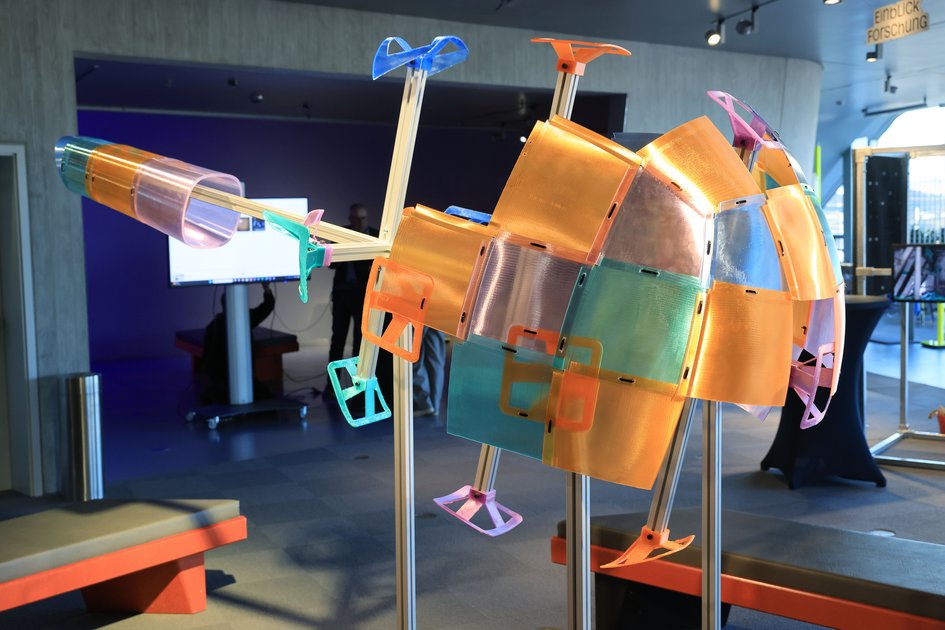
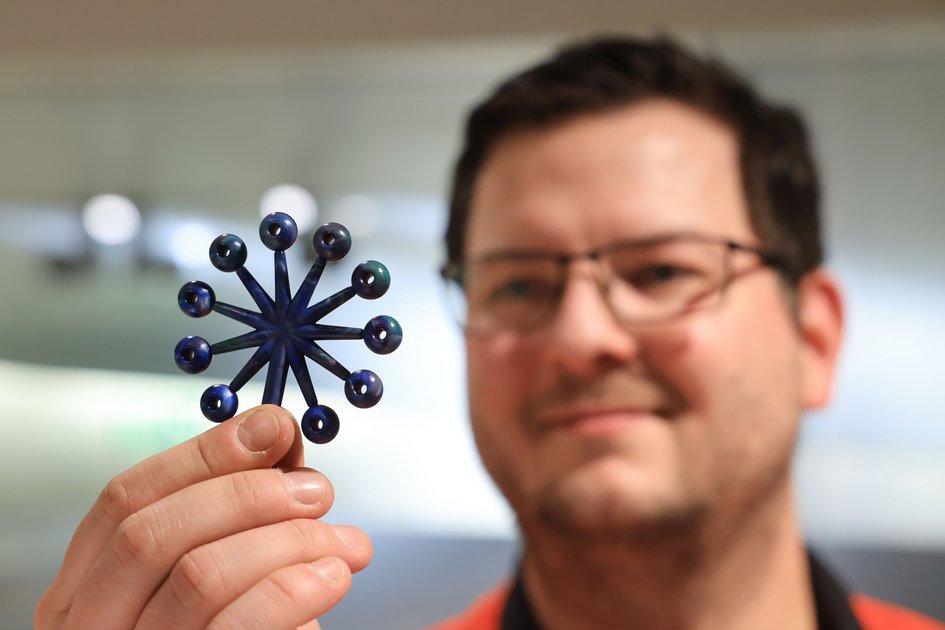
At the heart of the Forum is the Plastic Comet, an artistic installation that grows in response to visitors’ feedback. Through four possible responses, visitors explore how they would react to the challenges posed by plastics. Their answers are visualised through coloured, 3D-printed elements, transforming the installation into a collectively growing work of art.
The installation is complemented by three stations:
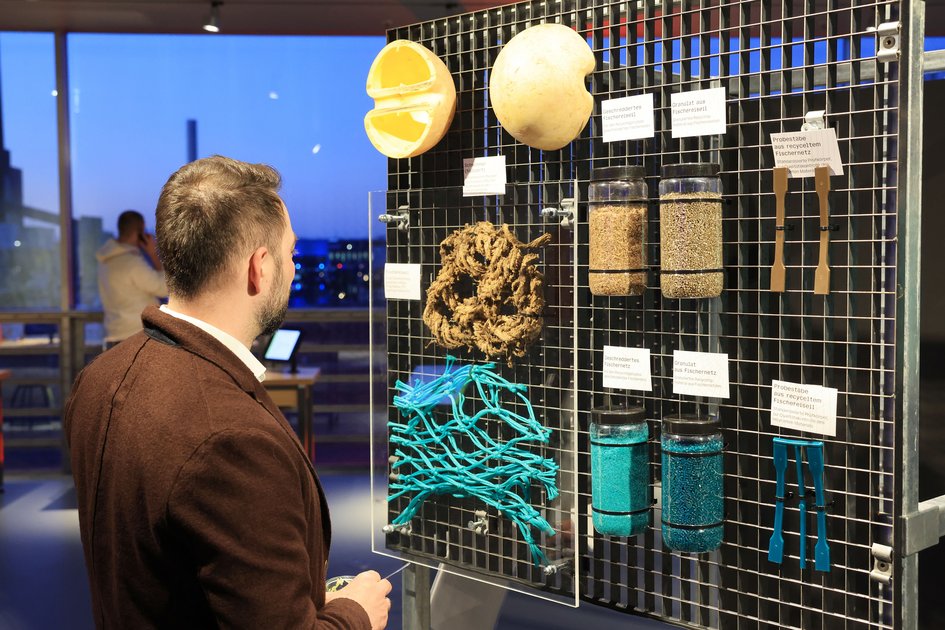
- Durability of plastics: Using different stages of fishing nets, the installation illustrates how a durable material can turn into microplastics through use and ageing.
- Diversity of plastics: Cross-sections of everyday objects show how complex material combinations are structured and why firmly bonded layers of plastic can make recycling difficult.
- Icons made of plastic: Historical objects illustrate how the properties of plastics – such as their light weight, mouldability and durability – have enabled new product forms and applications and shaped industrial mass production.
In this way, the forum combines technical information with illustrative objects and explores the question of what a responsible approach to plastics might look like in the future.
From knowledge to hands-on experimentation: The Plastics Future Lab
In the Plastics Future Lab, visitors can explore the properties and potential uses of the material for themselves. Hands-on stations demonstrate how plastics can be examined, sorted and prepared for recycling.
These include, for example, identifying materials using an infrared scanner, experiments on the perception and examination of plastics, and hands-on experience with sorting and recycling. Creative activities also demonstrate how used materials and old fishing nets can be reused.
In addition, phaeno offers the school workshop ‘Is that plastic or can it be thrown away?’. Pupils in Years 7 to 10 explore the properties of plastics, waste separation and the challenges of recycling. By shredding and reprocessing used plastic, they experience first-hand how something new can be created from waste material.
Thinking ahead on circularity together
ZuKUNSToff demonstrates that a functioning circular economy does not depend solely on suitable recycling processes and materials technologies. Equally important is how plastics are used, disposed of and recycled in everyday life, and how people and organisations make decisions about their use of resources.
To bring these interconnections to life, participatory formats such as the ‘Future Postcards’, the ‘Auction of the Last Coal’ and the ‘Treasury 2080’ have been developed. They give visitors the opportunity to contribute their own ideas and discover different perspectives. The aim is not to convey a single ‘correct’ answer, but to help visitors better understand complex interrelationships and develop their own ideas about a sustainable approach to resource management.
Research meets practice
ZuKUNSToff was implemented by Ostfalia University of Applied Sciences in collaboration with the phaeno Science Centre in Wolfsburg. The project combines materials research and recycling expertise with science communication and hands-on learning in a publicly accessible learning environment.
The starting point included findings from the REVFIN research and transfer project (“Prevention, reduction and recycling of fishnet pollution in Vietnamese coastal waters”), which focuses on strategies to tackle plastic waste from fishing nets and ropes in Vietnamese coastal waters. This research provides a technical backdrop for exploring the properties of plastics, their lifespan and their potential for recycling.
The exhibition content and prototypes were developed through a co-creative process involving not only Ostfalia and the curators at phaeno, but also the Interactive Media working group, as well as current and former students. This resulted in an interdisciplinary approach that combines scientific content with design, practical testing and accessible communication.
Funding
ZuKUNSToff was funded as part of the Volkswagen Foundation’s ‘Circularity in Everyday Life’ ideas competition. The project was developed and implemented by Ostfalia University of Applied Sciences in collaboration with the phaeno Science Centre.
Project management and collaboration
Project Management
Prof. Dr. phil. habil. Harald Rau
Chair of Communication Management
Ostfalia University of Applied Sciences, Salzgitter Campus
Industry partner
phaeno (external link, opens in a new window) gGmbH – Science Centre Wolfsburg
Alexandra Schautz, Biology Curator and Head of the Visitor Laboratories
Academic collaboration
Institute for Recycling, Ostfalia University of Applied Sciences, Wolfsburg Campus; Chair of Communication Management, Salzgitter Campus; Interactive Media Research Group (external link, opens in a new window); and current and former students of Ostfalia.
Project Management
Prof. Dr. phil. habil. Harald Rau
Building A, Room A.EG.38, Salzgitter
KomMa - Professur für Kommunikationsmanagement
Büro Mitarbeiterinnen und Mitarbeiter: A.EG.37 (CoWorking-Space), A.EG.40, A.EG.42